
What Is a Load Flow Study and Why It Matters (Expanded Technical Guide)
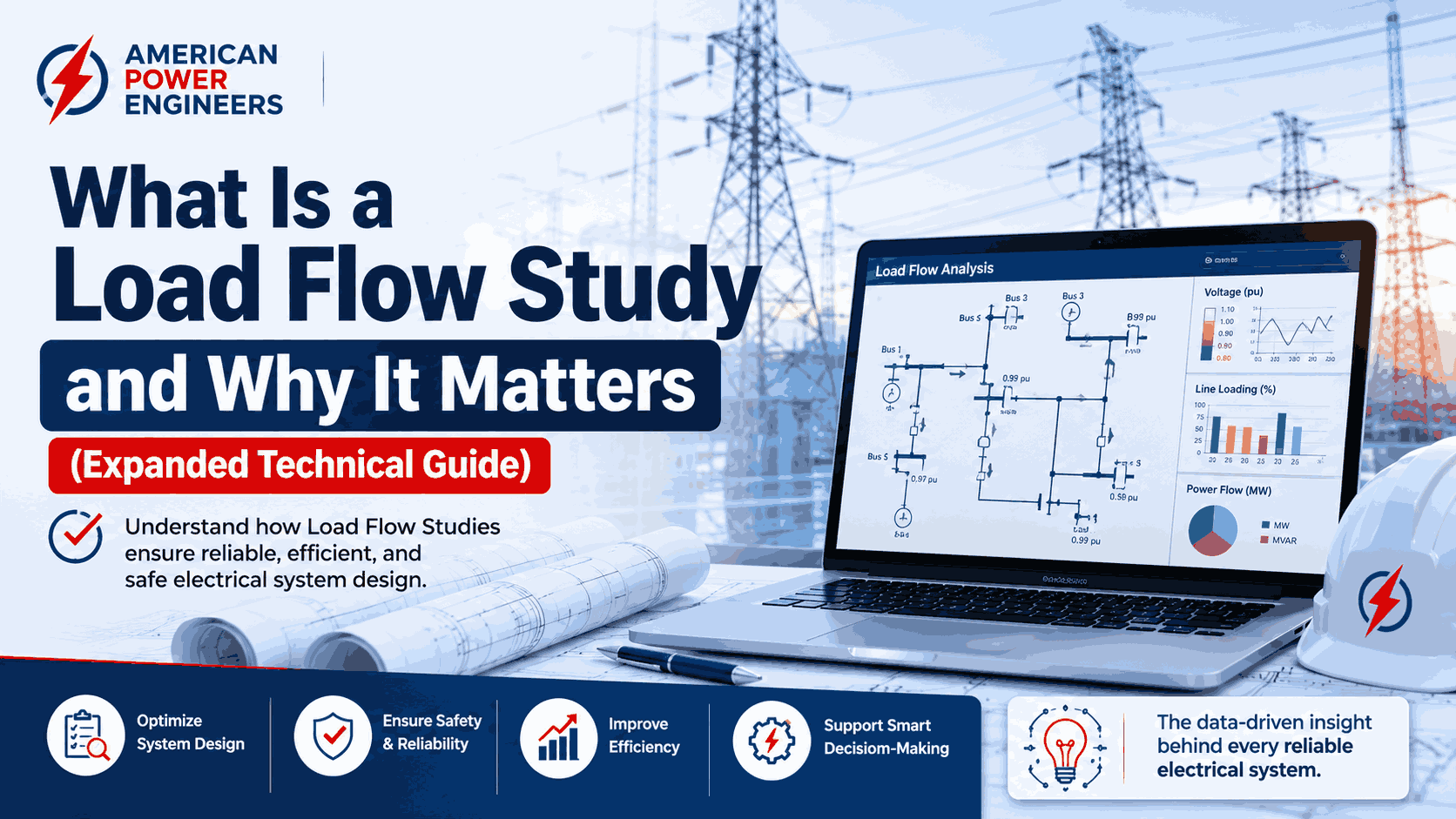
If you’ve ever asked a utility, an EPC, or an interconnection authority why your project needs a load flow study before it can move forward, you’re not alone. It’s one of the first technical requirements almost every power system project runs into and one of the least explained.
This guide breaks down load flow study explained in plain terms first, then goes deep into the methodology, so both project owners and engineers walk away with a working understanding of what the study does, why it’s required, and what problems it actually prevents.
What Is a Load Flow Study?
A load flow study also called a power flow study is a steady-state analysis that calculates the voltage, current, real power (MW), and reactive power (MVAR) at every bus and branch in an electrical network under a defined set of operating conditions.
In simpler terms: it answers the question “If this system is carrying this much load and generation right now, what does every point in the network actually look like?” That includes:
- Bus voltages — are they within acceptable limits (typically ±5–10% of nominal), or is a section of the system running too high or too low?
- Real and reactive power flow — how much power is moving through each line, cable, and transformer, and in which direction?
- Equipment loading — is any transformer, cable, or breaker operating above its rated capacity?
- System losses — how much power is being lost as heat across the network, and where?
Unlike a short circuit study (which models abnormal fault conditions) or a dynamic stability study (which models the system’s response over milliseconds to seconds after a disturbance), a load flow study models the system as it normally operates a steady-state snapshot, or a series of snapshots across different operating scenarios.
Need Engineering Support for Your Power Project?
American Power Engineers delivers power system studies, substation design, renewable energy engineering, BESS projects, NERC compliance, MEP engineering, and POI interconnection services.
Explore Our Engineering ServicesWhy a Load Flow Study Matters
A load flow study isn’t a formality — it’s the study that catches problems before they become expensive or dangerous. Here’s what it’s actually solving for:
1. Voltage violations.
Without a load flow study, you don’t know if adding a new load, generator, or line will push a bus voltage outside acceptable limits — which can trip protective equipment, damage sensitive loads, or cause nuisance outages.
2. Equipment overloading.
Transformers, cables, and breakers all have thermal ratings. A load flow study tells you, quantitatively, whether your equipment can carry the power you’re asking it to carry — under normal conditions and under contingency (N-1) conditions, such as a line or transformer being taken out of service.
3. Interconnection approval.
If you’re connecting a new generator, solar farm, wind farm, or BESS project to the grid, the interconnecting utility will require a load flow study (often as part of a broader interconnection study) to confirm your project won’t cause voltage or thermal violations on their system.
4. Capital planning.
Load flow results tell you where the real bottlenecks are in a system — so capacity upgrades, new substations, or reconductoring projects get targeted at the locations that actually need it, instead of guessing.
5. Renewable and BESS integration.
Solar, wind, and battery storage introduce variable, bidirectional power flows that traditional systems weren’t designed around. A load flow study run across multiple generation scenarios (full output, no output, ramping) is essential to confirm the system stays within limits across the full range of conditions.
Planning a Solar, Wind, BESS, or Grid Interconnection Project?
Our engineering team helps project owners, developers, utilities, and facility teams move from technical planning to reliable project execution.
View Engineering ServicesHow a Load Flow Study Is Performed
Step 1: Data Collection
Engineers gather a single-line diagram, transformer nameplate data, cable/conductor specifications, protective device settings, and real/reactive power values for every load and generation source in the system.
Step 2: System Modeling
Each network element generators, transformers, transmission lines, cables, and loads is represented mathematically. Buses are the connection points where power enters or leaves the system; branches are the lines, cables, and transformers connecting them.
Step 3: Solving the Load Flow Equations
Power flow equations are nonlinear voltage magnitude and phase angle at every bus depend on every other bus simultaneously. Because of this, load flow studies use iterative numerical methods rather than direct algebraic solutions:
- Newton-Raphson Method — the industry standard for most utility and industrial systems; fast, accurate convergence even for large, complex networks.
- Gauss-Seidel Method — simpler and slower, generally reserved for smaller networks or preliminary estimates.
- Fast Decoupled Method — used where computational speed matters more than precision, common in large transmission planning studies.
Every solved system needs a slack bus — a reference bus that balances the difference between total generation and total load (since system losses aren’t known until the study is solved). Without a slack bus, the equations have no fixed reference point for voltage angle and can’t be solved.
Step 4: Scenario Analysis
A single “base case” load flow rarely tells the whole story. Engineers typically run multiple scenarios: peak load, minimum load, various generation dispatch combinations, and N-1 contingencies (one major component out of service) to confirm the system holds up across realistic operating conditions — not just the best case.
Step 5: Results Interpretation
The output — bus voltages, line flows, transformer loading, and losses — is compared against equipment ratings and utility/interconnection voltage criteria to flag violations and inform next steps (equipment upgrades, reactive power compensation, reconfiguration, etc.).
Common Problems a Load Flow Study Uncovers
- Voltage drops on long feeders, especially in rural or utility-scale renewable interconnections where the point of interconnection is far from the point of generation.
- Reverse power flow on circuits not originally designed for bidirectional flow, a frequent issue with distributed solar and BESS projects.
- Transformer or cable overloading that wasn’t obvious from a simple capacity check, because it only shows up under specific dispatch or contingency conditions.
- Poor power factor, which increases losses and can trigger utility penalties, often correctable with capacitor banks or reactive power compensation identified directly from the study results.
Load Flow Study vs Related Power System Studies
It’s easy to conflate a load flow study with other power system studies, so here’s the quick distinction:
| Study | What It Models | Typical Use |
| Load Flow Study | Steady-state normal operation | Planning, interconnection, capacity checks |
| Short Circuit Study | Abnormal fault conditions | Equipment rating, protection settings |
| Arc Flash Analysis | Incident energy during an arcing fault | Worker safety, PPE selection |
| Dynamic Stability Study | System response in cycles-to-seconds after a disturbance | Grid stability, generator/inverter tuning |
If you’re new to power system studies generally, our power system studies team performs load flow, short circuit, arc flash, relay coordination, and harmonic analysis as part of an integrated study scope because in practice, these studies build on each other rather than standing alone.
When Do You Need a Load Flow Study?
- Before connecting new generation (solar, wind, BESS) to a utility system
- Before adding significant new load to an existing facility
- During substation design or upgrade planning — see our substation design services for how load flow results feed directly into equipment specification
- When troubleshooting voltage complaints, nuisance trips, or unexplained losses in an existing system
- As part of routine system planning for utilities and industrial facilities, typically on a multi-year review cycle
If your project also requires a fault current or safety analysis alongside the load flow study, our arc flash analysis guide explains how that study builds on load flow and short circuit results.
FAQs
What is the difference between a load flow study and a power flow study?
Nothing — the terms are used interchangeably in power engineering. Both refer to the same steady-state analysis of voltage, current, and power flow across a network.
What is the difference between a load flow study and a short circuit study?
A load flow study models the system under normal operating conditions. A short circuit study models the system under abnormal fault conditions, calculating fault current magnitudes used to size equipment and set protective devices. Most engineering scopes include both, because short circuit results depend on the network configuration established during the load flow model.
Why is the slack bus necessary in a load flow study?
System losses aren’t known until the load flow equations are solved, so one bus — the slack bus — must absorb the difference between total generation and total load. It also provides the fixed voltage angle reference the equations need to be mathematically solvable.
How often should a load flow study be updated?
For utilities and large industrial systems, load flow models are typically reviewed and updated every 3–5 years, or whenever a significant change occurs — new generation, major load additions, or a system reconfiguration. Interconnection-driven load flow studies are typically a one-time requirement per project, though re-studies may be triggered by subsequent interconnection requests in the same area.
Can a load flow study identify why voltage is fluctuating at my facility?
Yes. Voltage fluctuation complaints are one of the most common reasons an existing facility commissions a load flow study — it identifies whether the cause is undersized conductors, transformer tap settings, poor power factor, or loading conditions elsewhere on the shared circuit.
Do renewable energy projects need a different kind of load flow study?
Not a different type, but a broader scope. Solar, wind, and BESS projects introduce variable and often bidirectional power flow, so the study needs to be run across multiple generation scenarios — full output, zero output, and various states of charge for storage — rather than a single fixed-load case.
What software is used to perform a load flow study?
Common industry tools include ETAP, PowerWorld, PSS/E, and CYME, among others. The choice of software matters less than the accuracy of the underlying system data and the engineering judgment applied to interpreting results — a study is only as good as the model behind it.
Is a load flow study required for interconnection approval?
In most cases, yes. Utilities and grid operators require a load flow analysis (often as part of a broader interconnection study package) to confirm that a new generator, load, or storage system won’t cause voltage or thermal violations on the existing system before granting interconnection approval.
Whether you’re planning a new interconnection, troubleshooting voltage issues, or preparing for a capacity expansion, a properly scoped load flow study is the foundation everything else gets built on.
Our power system studies team performs IEEE- and ANSI-aligned load flow analysis for utilities, developers, and industrial clients across North America.
Request a Load Flow Study | Power System Studies | Browse More Technical Articles
Work With American Power Engineers
Expert engineering support for power system studies, substation design, renewable energy projects, BESS engineering, NERC compliance, MEP engineering, and POI interconnection services.
Explore All Engineering Services