
Arc Flash Hazard Analysis: What NFPA 70E Requires and How Studies Are Performed
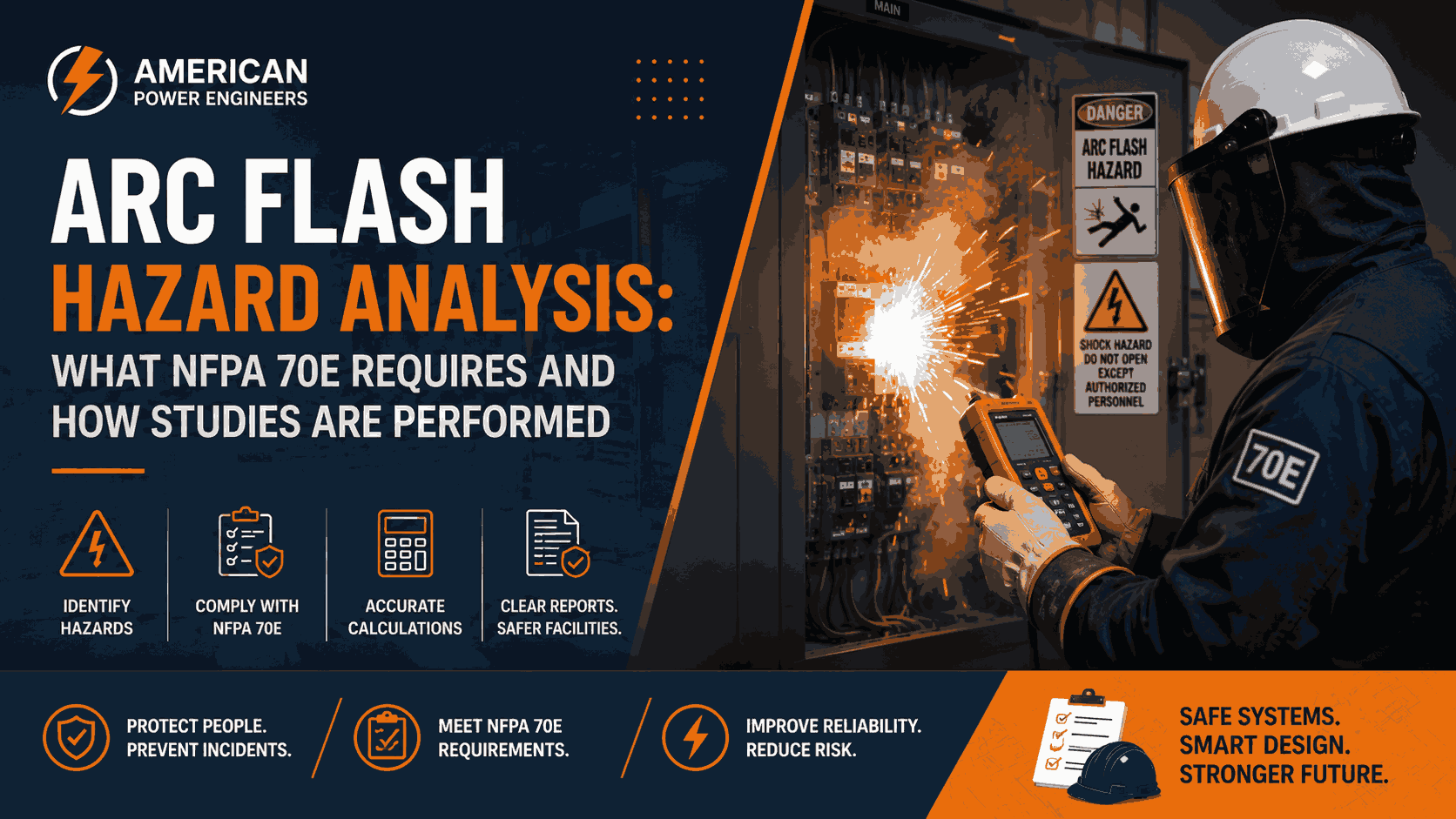
If your facility has electrical equipment that workers examine, adjust, or service while energized, you’re already inside the scope of NFPA 70E — whether or not a study has ever been performed. An arc flash hazard analysis is the engineering study that turns that legal exposure into a concrete, documented answer: how much incident energy exists at each piece of equipment, what PPE is required, and where the safe working boundaries are.
This guide covers what NFPA 70E actually requires, how a compliant study is performed, and the problems we most often find when we walk into a facility that “already has an arc flash study” on file.
What Is Arc Flash Hazard Analysis?
Arc flash hazard analysis is the engineering process of calculating the incident energy released during an arcing fault at each piece of electrical equipment in a facility, then translating that value into safe work boundaries and PPE requirements. It’s distinct from a generic arc flash label a label is the output; the analysis is the engineering work behind it.
For the underlying calculation methodology (IEEE 1584-2018 arcing current models, enclosure factors, and incident energy formulas), see our companion guide, Arc Flash Analysis: What It Is, Why It Matters, and How It’s Done. This article focuses on the compliance side: what the standard requires and how the study process actually runs on a real project.
What NFPA 70E Actually Requires
NFPA 70E Standard for Electrical Safety in the Workplace is a consensus standard, not a federal law but OSHA enforces electrical safety through the General Duty Clause and 29 CFR 1910.269/1910.333 and routinely references NFPA 70E as the recognized industry practice for demonstrating compliance.
Need Engineering Support for Your Power Project?
American Power Engineers delivers power system studies, substation design, renewable energy engineering, BESS projects, NERC compliance, MEP engineering, and POI interconnection services.
Explore Our Engineering ServicesIn practice, that means an employer without a documented arc flash hazard analysis has very little to point to if an incident or audit occurs.
Article 130.5 of NFPA 70E is the core requirement, and it breaks down into a few specific obligations:
- An arc flash risk assessment is required before any employee works on or near energized electrical conductors or circuit parts, wherever exposure could result in injury.
- Incident energy must be calculated (or a PPE category table method used, in limited cases) to determine the arc flash boundary and required PPE for each piece of equipment.
- Field labeling is mandatory. Labels must show nominal system voltage, the arc flash boundary, and either the incident energy value with working distance, or the applicable PPE category — not just a generic warning sticker.
- The analysis must be reviewed for accuracy at intervals not exceeding five years, and updated sooner whenever the electrical system changes in a way that could affect the results.
One clarification worth making explicitly, because it’s a frequent point of confusion: the NEC’s requirement for an arc flash warning label on service equipment is not the same thing as an NFPA 70E-compliant incident energy analysis. A label can exist without a real study behind it and that gap is exactly where facilities get exposed during an OSHA investigation or insurance audit.
How an Arc Flash Hazard Analysis Study Is Performed
A properly executed study follows a consistent engineering sequence, regardless of facility size:
1. Data Collection and Field Survey
Engineers collect single-line diagrams, transformer nameplates, conductor and cable data, protective device settings, and utility source impedance. Where records are incomplete or out of date — common in facilities more than 10–15 years old — a field survey verifies actual installed equipment against drawings.
2. Short Circuit Study
Available fault current is calculated at every bus and equipment location, since incident energy is directly driven by fault current magnitude.
Planning a Solar, Wind, BESS, or Grid Interconnection Project?
Our engineering team helps project owners, developers, utilities, and facility teams move from technical planning to reliable project execution.
View Engineering Services3. Protective Device Coordination Review
Clearing times for breakers, fuses, and relays are determined from time-current characteristics, because clearing time has as much influence on incident energy as fault current does.
4. Incident Energy Calculation (IEEE 1584-2018)
Using the fault current and clearing time data, incident energy is calculated at each equipment location, accounting for bus gap, enclosure type, and working distance.
5. Boundary Determination and PPE Category Assignment
The arc flash boundary (the distance at which incident energy drops to 1.2 cal/cm²) and required PPE category are established for every piece of equipment analyzed.
6. Labeling and Reporting
Field labels are issued for each piece of equipment, along with a full engineering report documenting methodology, assumptions, findings, and — critically — recommendations for reducing incident energy where levels are elevated.
Our power system studies team runs this full sequence as part of a standards-aligned study, so the deliverable holds up under an OSHA review, not just a visual inspection.
Common Triggers That Require a New or Updated Study
Beyond the five-year review cycle, several changes should trigger an immediate reassessment rather than waiting for the interval to expire:
- Utility system upgrades that change available fault current
- New transformers, switchgear, or protective devices
- Relay or breaker setting changes made during maintenance
- Facility expansions or new equipment additions
- Any near-miss or arc flash incident, which should always prompt a review of the assumptions behind the existing study
Problems We Commonly Find in Existing Arc Flash Programs
Facilities rarely come to us with no arc flash documentation at all more often, they have something in place that turns out to be incomplete or outdated. The recurring issues:
- Labels exist, but no engineering study backs them. Someone installed generic labels years ago to satisfy an audit checklist, with no incident energy calculation behind the numbers.
- The study is technically current but the system isn’t. A transformer was replaced or breaker settings changed after the study was completed, and the labels were never updated to match.
- PPE category tables were used where a facility-specific study was actually required. NFPA 70E’s table method has real limitations and isn’t a substitute for calculated incident energy on complex or higher-fault-current systems.
- Protective device coordination was never reviewed alongside the arc flash study, meaning the calculated clearing times don’t reflect how the system will actually behave during a fault.
If any of that sounds familiar, it’s worth treating your existing documentation as a starting point for a gap review rather than assuming it’s still valid.
Reducing Incident Energy Through Engineering
A well-executed study doesn’t stop at calculating a number — it identifies where engineering changes can lower incident energy and reduce required PPE, through faster protective device clearing times, current-limiting fuses, zone-selective interlocking, or arc flash detection relays. We cover these mitigation strategies in more depth in our arc flash analysis engineering guide.
This same protection and coordination work also matters well before a facility is operating. On interconnection-driven projects solar, wind, and BESS facilities connecting to a regional grid protective device coordination and fault current analysis feed directly into the utility’s interconnection requirements; see our ERCOT interconnection services for how that coordination is handled during POI studies, and how it connects back to the facility-level arc flash work covered here.
For facilities operating under NERC-jurisdictional requirements as well, coordination between arc flash studies and broader compliance documentation matters — our NERC O&P 693 compliance services team can help align both workstreams.
FAQs
Does OSHA legally require an arc flash study?
OSHA doesn’t name “arc flash study” directly in its regulations, but its general electrical safety standards (1910.269, 1910.333) and the General Duty Clause create a de facto requirement, since NFPA 70E is the recognized consensus standard OSHA points to for compliance. In practice, a facility without a documented study has little defense in an audit or after an incident.
How often does an arc flash study need to be updated?
NFPA 70E requires the analysis to be reviewed for accuracy at intervals not exceeding five years. However, that five-year mark is a ceiling, not a guarantee — any significant system change (new equipment, relay setting changes, utility fault current changes) should trigger a sooner review of the affected areas.
Can I just use the NFPA 70E PPE category tables instead of a full study?
The table method is permitted under specific, limited conditions defined in NFPA 70E, but it has real restrictions on fault current and clearing time assumptions. For most utility-scale, industrial, or higher-fault-current systems, a facility-specific incident energy calculation gives more accurate — and often lower — PPE requirements than the conservative table values.
Who is qualified to perform an arc flash hazard analysis?
NFPA 70E doesn’t mandate a specific license, but a defensible study requires engineers experienced in IEEE 1584 modeling, protective device coordination, and power system analysis — not just software proficiency. Judgment about how utility contribution, protection schemes, and maintenance conditions affect the model matters as much as the calculation itself.
What’s the difference between an arc flash label and an arc flash study?
A label is the field-facing output — voltage, boundary, incident energy or PPE category. The study is the engineering work that produces those numbers. A label without a study behind it, or with outdated study data, does not satisfy NFPA 70E’s actual requirements.
How long does an arc flash hazard analysis take?
Depending on facility size and data availability, a study typically runs four to six weeks from data collection through final labeling and reporting. Facilities with incomplete or outdated single-line diagrams should expect additional time for the field verification stage.
Arc flash hazard analysis isn’t a one-time compliance checkbox — it’s a living part of your electrical safety program that needs to track every change made to your system. If your facility’s last study predates recent equipment changes, or you’re not confident the labels on your equipment reflect a real incident energy calculation, that’s worth resolving before it becomes an audit finding or, worse, an incident.
Ready to get your arc flash program current? Request a proposal or explore our full power system studies capabilities.
Work With American Power Engineers
Expert engineering support for power system studies, substation design, renewable energy projects, BESS engineering, NERC compliance, MEP engineering, and POI interconnection services.
Explore All Engineering Services