
IEEE 2800-2022 Explained: What It Means for Inverter-Based Resource Interconnection
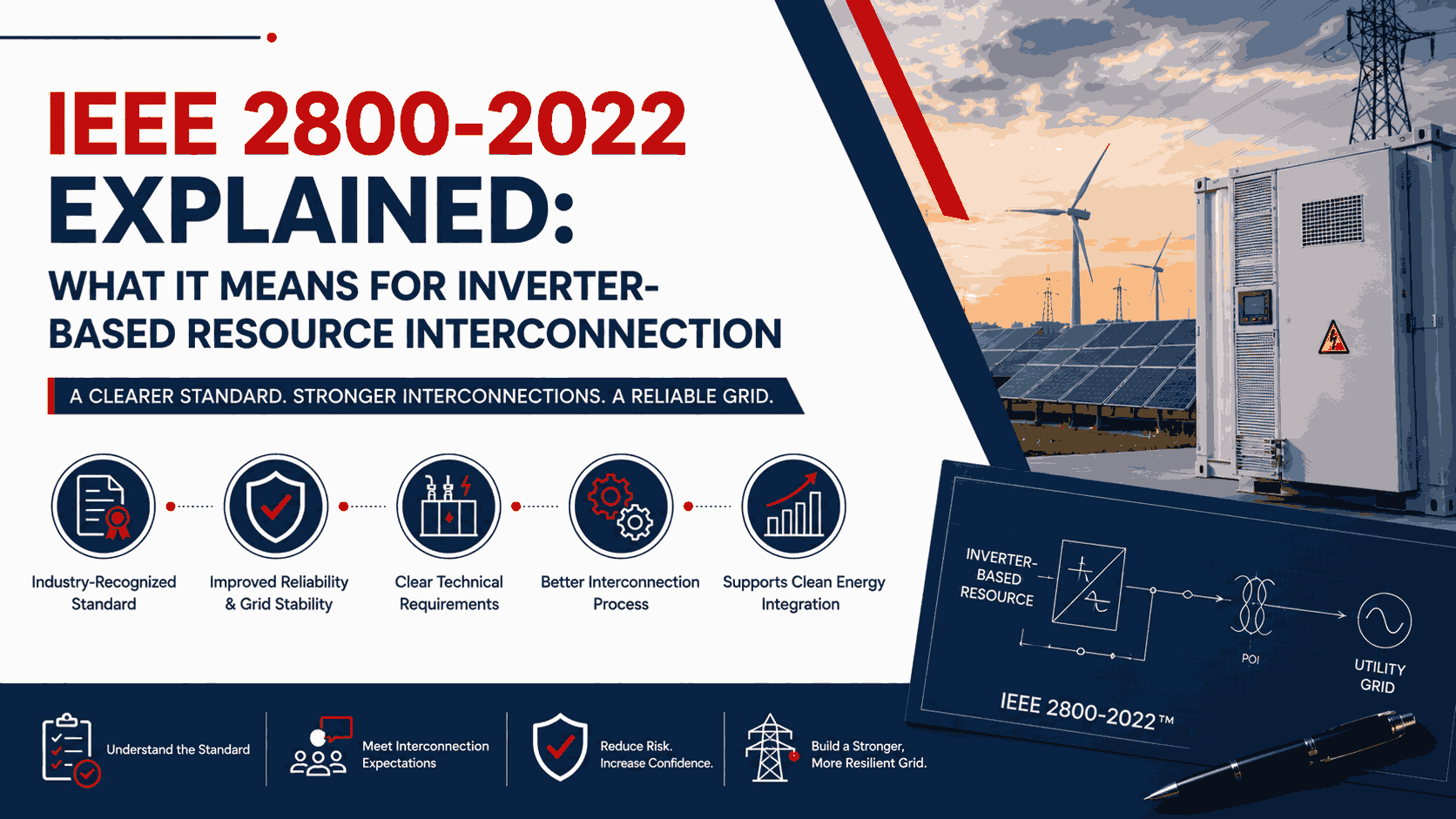
If you’re developing, financing, or operating a solar farm, wind project, or battery energy storage system, you’ve likely run into the same wall during interconnection: your transmission utility or ISO is now asking for IEEE 2800-2022 compliance documentation, and your existing generator interconnection agreement template doesn’t say much about what that actually means.
This guide breaks down IEEE 2800-2022 in plain, practical language: what it requires, why it exists, how it relates to NERC’s PRC-029 standard, and what developers and generator owners need to do to get through interconnection review without costly rework.
What Is IEEE 2800-2022?
IEEE 2800-2022, formally titled IEEE Standard for Interconnection and Interoperability of Inverter-Based Resources (IBRs) Interconnecting with Associated Transmission Electric Power Systems, is the first industry-wide technical standard establishing uniform minimum requirements for how inverter-based resources solar PV, wind, and battery energy storage must perform when connected to transmission and sub-transmission systems.
It was published by the IEEE Standards Association on April 22, 2022, after several years of development involving transmission planners, NERC, EPRI, NATF, and renewable industry groups including SEIA and ACP.
The trigger was simple: as inverter-based resources (IBRs) replaced synchronous generators as the dominant new source of generation, grid operators kept running into the same recurring reliability problems unexpected mass tripping during grid disturbances, unwanted cessation of active power, and inconsistent behavior between projects because every interconnecting utility had its own, often incompatible, technical requirements.
Need Engineering Support for Your Power Project?
American Power Engineers delivers power system studies, substation design, renewable energy engineering, BESS projects, NERC compliance, MEP engineering, and POI interconnection services.
Explore Our Engineering ServicesIEEE 2800-2022 exists to fix that fragmentation by giving every Transmission Planner, Planning Coordinator, and generator owner a single, consistent technical reference for how an IBR is supposed to behave — before, during, and after a grid disturbance.
Need Engineering Support for Your IBR Interconnection Project?
American Power Engineers helps developers and generator owners navigate IEEE 2800-2022, NERC PRC-029, and utility-specific interconnection requirements from feasibility study through commissioning.
Explore Our Interconnection Engineering Services →
Who Does IEEE 2800-2022 Apply To?
IEEE 2800-2022 applies to inverter-based resources interconnecting at transmission and sub-transmission voltage levels generally interconnections at 69 kV and above, though the exact voltage threshold that triggers applicability is ultimately defined by the interconnecting Transmission Planner or Planning Coordinator, since regional practices vary.
The standard covers:
- Utility-scale solar PV plants
- Utility-scale wind farms (both Type III and Type IV wind turbine generators)
- Battery energy storage systems (BESS), standalone or hybrid/co-located
- Isolated IBRs connected via dedicated VSC-HVDC facilities (in these cases, the standard applies to the combined IBR + HVDC facility)
It currently does not apply to distribution-connected resources (that space is governed by IEEE 1547), though industry groups are actively discussing how the two standards should eventually align as distributed generation grows.
Planning a Solar, Wind, BESS, or Grid Interconnection Project?
Our engineering team helps project owners, developers, utilities, and facility teams move from technical planning to reliable project execution.
View Engineering ServicesWhy IEEE 2800-2022 Was Created: The Problem It Solves
Before IEEE 2800-2022, interconnection requirements for IBRs were a patchwork. Each transmission owner, ISO, or RTO wrote its own version of ride-through, voltage support, and protection requirements, sometimes too lenient, sometimes unnecessarily conservative and rarely consistent from one region to the next.
That inconsistency created real problems:
- Reliability events where large blocks of solar or wind generation unexpectedly tripped offline during a single disturbance, amplifying the event instead of riding through it.
- Interconnection delays as developers scrambled to reconcile conflicting requirements from different utilities on multi-region portfolios.
- Stranded investment risk when equipment specified early in a project didn’t ultimately meet the interconnecting utility’s requirements, forcing expensive control-system or hardware changes late in construction.
IEEE 2800-2022 addresses this by defining one common technical baseline that every jurisdiction can adopt or reference, reducing ambiguity for developers building projects across multiple ISO/RTO footprints.
The Core Technical Requirements in IEEE 2800-2022
At roughly 280 pages, IEEE 2800-2022 is dense but its requirements fall into five practical categories that matter most for project planning:
1. Voltage and Frequency Ride-Through
IBRs must remain connected and continue operating through defined voltage sags, swells, and frequency deviations rather than tripping offline, unless conditions exceed clearly defined “may trip” boundaries. This is the requirement most directly tied to preventing the mass-tripping events that originally drove the standard’s creation.
2. Active and Reactive Power Control
The standard sets minimum reactive power capability requirements including reactive power capability at zero active power output so IBRs can continue supporting grid voltage even when solar irradiance or wind resource is unavailable.
3. Dynamic Grid Support
IBRs must provide dynamic active power support in response to abnormal frequency conditions and dynamic voltage support in response to abnormal voltage conditions essentially, the inverter has to actively help stabilize the grid during a disturbance, not just avoid tripping.
4. Power Quality and Negative Sequence Current
Requirements address harmonic distortion, flicker, and negative sequence current injection during unbalanced fault conditions, ensuring IBR behavior doesn’t introduce new power quality problems onto the transmission system.
5. System Protection and Modeling
Generator owners must provide validated dynamic and electromagnetic transient (EMT) models of their IBR plant for the interconnecting utility’s studies, and protection systems must be coordinated with the plant’s ride-through and current-limiting behavior an area closely tied to the kind of power system studies required during interconnection review.
Planning a Solar, Wind, or BESS Interconnection?
Our engineering team performs the dynamic modeling, ride-through studies, and protection coordination utilities required to demonstrate IEEE 2800-2022 and NERC PRC-029 compliance.
View Our Engineering Services →
How IEEE 2800-2022 Relates to NERC PRC-029
IEEE 2800-2022 is a voluntary IEEE standard by itself, it isn’t legally enforceable. It becomes mandatory only when a regulatory body or transmission owner formally adopts it into a binding requirement.
That’s exactly what has happened in North America. In response to FERC Order 901, NERC developed PRC-029, a new mandatory Reliability Standard that adopts key ride-through and performance requirements from IEEE 2800-2022 for inverter-based resources on the bulk electric system. In practice, this means:
- IEEE 2800-2022 defines the detailed technical how the specific ride-through curves, reactive power capability, and modeling requirements.
- NERC PRC-029 makes core elements of that technical framework a mandatory, auditable compliance obligation for generator owners.
If you’re building a compliance program, it’s worth reading these two documents as a pair rather than in isolation. We cover the mandatory compliance side of this relationship in more detail in our guide to NERC compliance for generator owners, including how PRC-029 fits alongside other applicable standards.
Common Problems Developers Run Into (and How to Avoid Them)
Based on the interconnection issues we see most often, here’s where IEEE 2800-2022 compliance tends to go wrong on real projects:
Problem: Inverter OEM equipment doesn’t meet ride-through requirements out of the box.
Many standard inverter firmware configurations are tuned for older, less stringent regional rules. Solution: confirm ride-through and reactive power capability against IEEE 2800-2022 during equipment selection before signing procurement contracts, not after.
Problem: Dynamic models submitted for interconnection studies don’t match as-built plant behavior.
Utilities increasingly require PSS/E, PSCAD, or EMT models validated against manufacturer type-test data. Mismatched models are one of the most common causes of interconnection study delays and re-studies.
Problem: Protection settings aren’t coordinated with IBR current-limiting behavior.
Inverters behave very differently from synchronous generators during faults they limit fault current rather than contributing many multiples of rated current. Protection schemes designed around synchronous-generator assumptions can fail to detect faults correctly on IBR-heavy feeders.
Problem: Grid region-specific requirements are treated as an afterthought.
Even with IEEE 2800-2022 as a common baseline, individual ISOs and RTOs are adopting and layering on their own implementation details, tariff language, and timelines. A project engineered generically for “IEEE 2800 compliance” without checking the specific interconnecting utility’s adoption details can still face utility pushback.
For example, developers interconnecting in Texas should see our ERCOT interconnection services for how the standard is being implemented in that market specifically.
What This Means for Your Project: A Practical Checklist
If you’re planning an IBR interconnection, use this as a starting checklist for IEEE 2800-2022 readiness:
- Confirm the interconnecting Transmission Planner’s specific voltage threshold and adoption status for IEEE 2800-2022 and NERC PRC-029.
- Verify inverter/OEM ride-through and reactive power capability against the standard’s minimum requirements during equipment selection.
- Commission validated dynamic (RMS) and EMT models early, and re-validate them against factory or field type-test data.
- Coordinate protection system design with IBR fault current-limiting behavior, not synchronous-generator assumptions.
- Confirm applicable requirements for your specific grid region — regional tariff implementation details vary even where the underlying technical standard is the same.
- Build compliance evidence and documentation as you go, since the same technical package will likely support your NERC PRC-029 obligations once the plant is in service.
FAQS
Is IEEE 2800-2022 mandatory?
Not on its own. IEEE 2800-2022 is a voluntary industry standard. It becomes a binding requirement when a transmission owner, ISO/RTO, or regulator formally incorporates it into an interconnection agreement, tariff, or a mandatory reliability standard as NERC has done through PRC-029.
Does IEEE 2800-2022 apply to my rooftop or distributed solar project?
Generally, no. IEEE 2800-2022 applies to transmission and sub-transmission-connected resources. Smaller, distribution-connected systems typically fall under IEEE 1547 instead.
What’s the difference between IEEE 2800-2022 and IEEE 1547?
IEEE 1547 governs distributed energy resources interconnecting at distribution voltage levels. IEEE 2800-2022 governs larger, utility-scale inverter-based resources connecting at transmission and sub-transmission voltage levels. The two standards address similar technical concepts (ride-through, power quality, protection) but at different scales and voltage classes.
How does IEEE 2800-2022 relate to NERC PRC-029?
IEEE 2800-2022 provides the detailed technical requirements; NERC PRC-029 is the mandatory reliability standard that adopts core elements of IEEE 2800-2022 as an enforceable compliance obligation for generator owners on the North American bulk electric system.
Does IEEE 2800-2022 apply to hybrid solar-plus-storage or standalone BESS projects?
Yes. The standard applies to inverter-based resources broadly, which includes standalone battery energy storage systems and hybrid/co-located solar-plus-storage facilities, in addition to wind and solar PV.
What studies do I need to demonstrate IEEE 2800-2022 compliance?
Typically, this includes dynamic (RMS) stability modeling, electromagnetic transient (EMT) studies for detailed fault behavior, reactive power capability verification, and protection coordination studies all tied together with validated equipment models submitted to the interconnecting utility.
Does IEEE 2800-2022 cover grid-forming inverters?
The original 2022 standard was written primarily around grid-following inverter behavior. An amendment to IEEE 2800-2022 specifically addresses reducing technical barriers for IBRs and converter-based resources that include grid-forming equipment, reflecting the industry’s growing interest in grid-forming technology.
Why Work With American Power Engineers on IEEE 2800-2022 Compliance
Navigating IEEE 2800-2022 alongside NERC PRC-029, utility-specific tariff requirements, and equipment procurement timelines takes engineering judgment, not just a copy of the standard. American Power Engineers supports developers, IPPs, and generator owners with:
- Ride-through and dynamic performance verification against IEEE 2800-2022 minimums
- PSS/E, PSCAD, and EMT model development and validation for interconnection studies
- Protection coordination engineering for IBR-heavy systems
- NERC PRC-029 compliance documentation support
- Grid region-specific interconnection guidance across ERCOT, MISO, PJM, CAISO, SPP, WECC, and NYISO
Related Services:
- POI Interconnection Engineering
- Power System Studies
- Utility-Scale Solar Farm Engineering
- Utility-Scale Wind Farm Engineering
- Utility-Scale BESS Engineering
- NERC O&P 693 Compliance Services
Work With American Power Engineers
Expert engineering support for power system studies, substation design, renewable energy projects, BESS engineering, NERC compliance, and POI interconnection services.
Work With American Power Engineers
Expert engineering support for power system studies, substation design, renewable energy projects, BESS engineering, NERC compliance, MEP engineering, and POI interconnection services.
Explore All Engineering Services