
EMT Analysis for Inverter-Based Resources: Why It Matters for Modern Grids
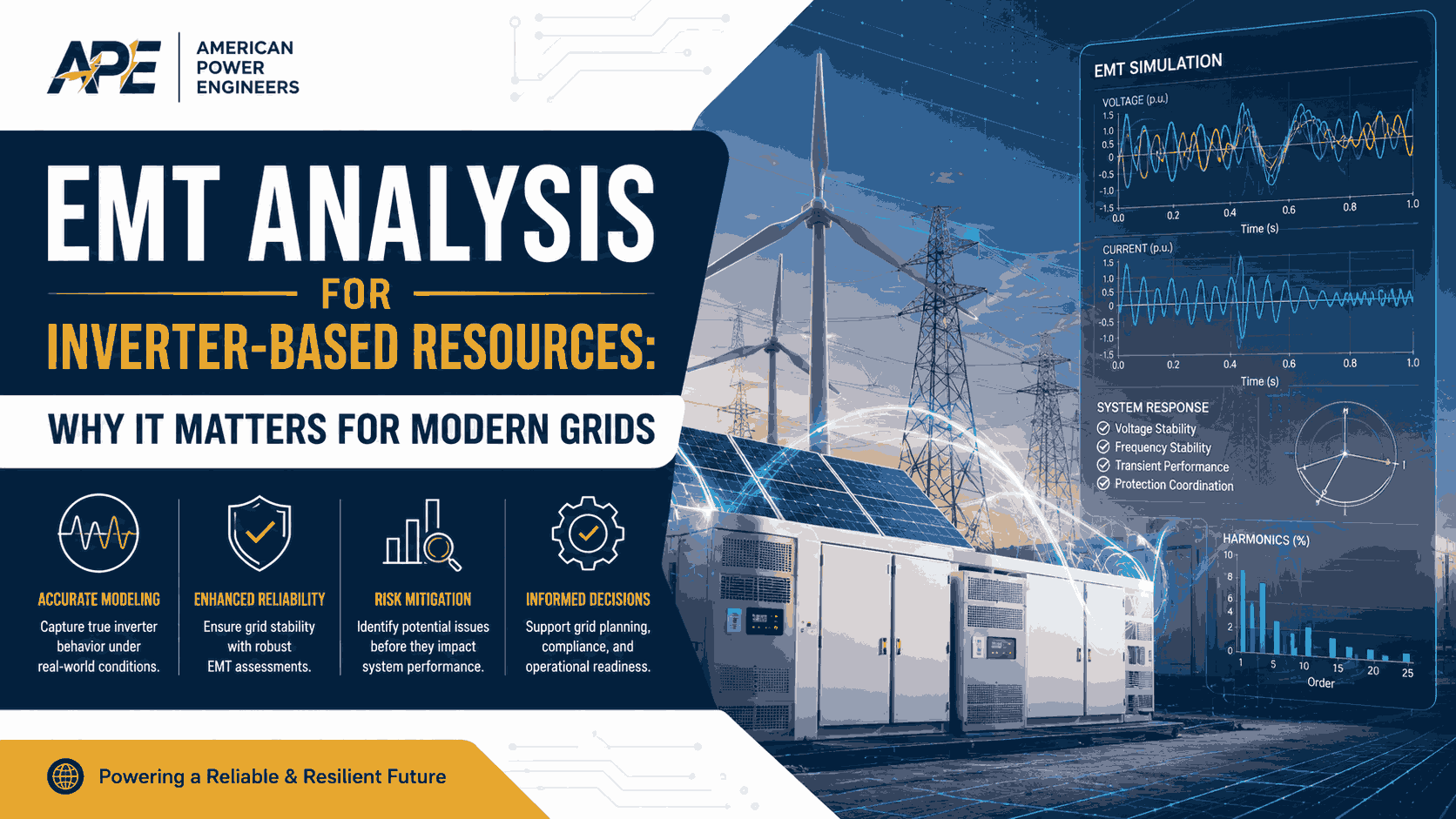
As solar, wind, and battery energy storage systems displace traditional synchronous generation, grid planners and interconnecting developers are running into a modeling problem that older study methods weren’t built for. EMT analysis for inverter-based resources has become one of the most consequential and most misunderstood requirements in modern interconnection studies.
This guide explains what EMT analysis is, why it matters specifically for inverter-based resources (IBRs), when it’s required, and how it fits into the broader interconnection and compliance process.
What Is EMT Analysis?
Electromagnetic Transient (EMT) analysis is a time-domain simulation method that models power system behavior at the level of instantaneous voltage and current waveforms, typically at microsecond-scale time steps. Unlike traditional steady-state or phasor-domain (RMS) studies, which represent the system using simplified 60 Hz phasor quantities, EMT simulation captures the actual waveform shape during fast transients switching events, faults, control interactions, and sub-cycle disturbances.
EMT studies are typically performed in specialized software such as PSCAD/EMTDC, and increasingly serve as the standard tool for evaluating how inverter-based resources actually behave on the grid, rather than how simplified models predict they should behave.
Why Inverter-Based Resources Need EMT Studies (Not Just RMS/Phasor Models)
Synchronous generators behave in relatively predictable, physics-governed ways during disturbances; their electromechanical inertia and well-understood rotor dynamics make phasor-domain (RMS) models reasonably accurate for planning studies.
Need Engineering Support for Your Power Project?
American Power Engineers delivers power system studies, substation design, renewable energy engineering, BESS projects, NERC compliance, MEP engineering, and POI interconnection services.
Explore Our Engineering ServicesInverter-based resources are fundamentally different. Their dynamic response is governed by power electronics and embedded control software not physical rotating mass — which means:
- Response times are orders of magnitude faster. IBR controls can react within milliseconds, well inside the sub-cycle window that RMS models simply don’t resolve.
- Behavior is proprietary and vendor-specific. Two inverters from different OEMs can respond very differently to the same fault, depending on undisclosed control logic.
- Weak grid conditions expose instability that phasor models miss. In areas with low Short-Circuit Ratio (SCR), typically below 3.0, IBR control loops can interact adversely with the grid impedance in ways RMS simulations cannot capture.
- Control interactions between multiple IBRs in the same interconnection area can create oscillations or instability that only appear in detailed time-domain simulation.
This is why regional grid operators and standards bodies increasingly require EMT-level study for IBR interconnection, particularly in renewable-dense or weak-grid areas.
Our power system studies team routinely sees interconnection requests where an RMS-only study passed screening, only for EMT-level review to surface stability concerns that required control tuning or additional grid support equipment.
EMT vs RMS/Phasor Domain Studies, Key Differences
| Factor | RMS / Phasor Studies | EMT Studies |
| Time resolution | Cycle-level (60 Hz phasor) | Microsecond-level waveform |
| Best suited for | Steady-state, transient stability screening | Fast transients, control interaction, weak-grid behavior |
| Captures inverter control logic | Simplified/generic models | Detailed, vendor-specific control models |
| Typical software | PSS/E, PowerWorld | PSCAD/EMTDC |
| Computation demand | Lower | Significantly higher |
| Required for | Broad system planning | Weak-grid IBR interconnection, protection studies, ride-through validation |
Most interconnection processes now use both: RMS/phasor studies for broad system-level planning, and EMT studies as a targeted, higher-fidelity check where fast dynamics or weak-grid conditions make phasor models unreliable.
When Is an EMT Study Required?
EMT analysis isn’t performed on every project it’s typically triggered by specific risk factors:
- Low Short-Circuit Ratio (SCR) interconnection points. Weak grid areas, common in high-renewable-penetration regions, are the most frequent trigger for EMT-level review.
- Grid-forming inverter projects. As more BESS and hybrid projects adopt grid-forming controls, EMT studies are used to validate stability under a wider range of grid strength conditions.
- Regional ISO/RTO requirements. Several grid operators — including ERCOT — require EMT modeling and model validation testing for IBR interconnection as part of their standard process, particularly for projects located in weak or congested grid areas. If your project is interconnecting in Texas, see our ERCOT interconnection services for how our team supports EMT model coordination alongside the broader interconnection study process.
- Protection coordination concerns. Fast fault current decay and non-standard fault current contribution from IBRs can create protection miscoordination that only EMT-level analysis reveals accurately.
- Post-disturbance investigation. When ride-through performance during a real grid event doesn’t match planning assumptions, EMT studies are used to reconcile modeled versus actual behavior.
Planning a Solar, Wind, BESS, or Grid Interconnection Project?
Our engineering team helps project owners, developers, utilities, and facility teams move from technical planning to reliable project execution including EMT model coordination for weak-grid and complex interconnection points.
Planning a Solar, Wind, BESS, or Grid Interconnection Project?
Our engineering team helps project owners, developers, utilities, and facility teams move from technical planning to reliable project execution.
View Engineering ServicesWhat an EMT Study Actually Evaluates
A well-scoped EMT study for an inverter-based resource typically examines:
- Low- and high-voltage ride-through (LVRT/HVRT) performance under realistic fault conditions
- Control interaction and stability between the IBR and the grid, and between multiple IBRs sharing an interconnection point
- Weak-grid stability margins, especially where SCR is at or near the threshold where phasor models lose accuracy
- Sub-synchronous or harmonic resonance risk introduced by inverter switching and control dynamics
- Protection system coordination, since IBR fault current contribution differs significantly from synchronous generation
The EMT Modeling Process
- Model acquisition. The OEM-supplied EMT model (often a compiled or “black-box” model) is obtained for the specific inverter, turbine, or BESS platform.
- Model validation and benchmark testing. The model is tested against known performance criteria in ERCOT’s case, this is formalized through Model Quality Tests (MQT) to confirm it behaves per the manufacturer’s stated specifications before it’s used in study.
- Scenario development. Fault locations, grid strength conditions, and disturbance types are defined based on the interconnection point’s known characteristics.
- Simulation and analysis. Cases are run in PSCAD/EMTDC, with results reviewed against ride-through, stability, and protection criteria.
- Reporting and coordination. Findings are documented and coordinated with the interconnecting utility or ISO, often alongside broader BESS engineering or solar farm engineering scope.
Need Engineering Support for Your Power Project?
American Power Engineers delivers power system studies, substation design, renewable energy engineering, BESS projects, NERC compliance, MEP engineering, and POI interconnection services.
Explore Our Engineering Services
Common Challenges in EMT Studies for IBRs
- OEM model availability and delays. Manufacturers don’t always release updated, platform-compatible EMT models on the developer’s project timeline, which can stall interconnection milestones.
- Proprietary “black-box” models. Vendor models often can’t be inspected in detail, which limits troubleshooting when unexpected behavior appears in simulation.
- Computational intensity. EMT simulations run far slower than phasor-domain studies, making large-scale, multi-scenario analysis time- and resource-intensive.
- A moving regulatory target. Standards and requirements for IBR modeling are still evolving — including ongoing work related to NERC Reliability Standard PRC-029 and reliability directives stemming from FERC Order 901 — which means study scope can shift mid-project.
Regulatory Landscape: IEEE 2800, NERC, and Regional ISO Requirements
IEEE 2800-2022, the standard for interconnection and interoperability of inverter-based resources with transmission systems, has become a reference point for ride-through, control, and modeling expectations across the industry.
In parallel, NERC’s reliability standards development including PRC-029 and related IBR performance requirements is pushing planning and operational study practices closer together, so that models used for interconnection approval better reflect real-world performance.
Regional grid operators are layering their own requirements on top of these standards. This is why understanding your specific interconnection region’s EMT and model validation requirements early rather than discovering them mid-study matters for project schedule and cost. Our NERC compliance team can help clarify which requirements apply to your project footprint.
Why Getting EMT Analysis Right Matters for Modern Grids
As renewable and storage penetration grows, grid reliability increasingly depends on inverter-based resources behaving predictably during disturbances not just in theory, but in the field. Getting EMT analysis right early in a project:
- Reduces the risk of late-stage redesign after an ISO or utility flags a stability concern
- Supports project bankability, since lenders and offtakers increasingly expect documented ride-through and stability performance
- Helps avoid protection miscoordination that could otherwise go undetected until a real fault event
- Keeps interconnection timelines on track by surfacing modeling gaps before they become schedule-critical
FAQs
What’s the difference between an EMT study and a transient stability (RMS) study?
An RMS/phasor study models the system using simplified 60 Hz quantities and is well-suited to broad system planning. An EMT study models actual waveform behavior at microsecond resolution, which is necessary to capture the fast, control-driven dynamics specific to inverter-based resources.
Does every IBR project need an EMT study?
No. EMT studies are typically triggered by specific conditions — most commonly weak-grid interconnection points (low SCR), grid-forming inverter technology, or a specific ISO/RTO requirement. Many projects only need standard RMS/phasor-domain planning studies.
What software is used for EMT analysis?
PSCAD/EMTDC is the industry-standard platform for EMT simulation of inverter-based resources, though other EMT-capable tools exist depending on utility or ISO preference.
Why do EMT model submissions sometimes delay interconnection timelines?
EMT models are usually supplied by the equipment OEM, and platform-specific, validated models aren’t always available on the developer’s schedule. Model validation testing (such as ERCOT’s Model Quality Tests) adds additional time before a model is accepted for use in study.
What is Short-Circuit Ratio (SCR), and why does it matter for EMT studies?
SCR measures grid strength relative to the size of the interconnecting resource. Low SCR (weak grid) conditions are where inverter control dynamics are most likely to interact adversely with the grid which is exactly the behavior EMT studies are designed to catch that phasor models miss.
Is EMT analysis only relevant to solar and wind, or does it apply to BESS too?
It applies broadly to any inverter-based technology solar PV, wind (Type 3/4 turbines), and battery energy storage with grid-forming BESS projects increasingly requiring EMT-level review given their more active role in grid stability.
Work With American Power Engineers
Expert engineering support for power system studies, substation design, renewable energy projects, BESS engineering, NERC compliance, MEP engineering, and POI interconnection services.
Work With American Power Engineers
Expert engineering support for power system studies, substation design, renewable energy projects, BESS engineering, NERC compliance, MEP engineering, and POI interconnection services.
Explore All Engineering Services