
FAT vs SAT in Renewable Energy Projects: What Is the Difference?
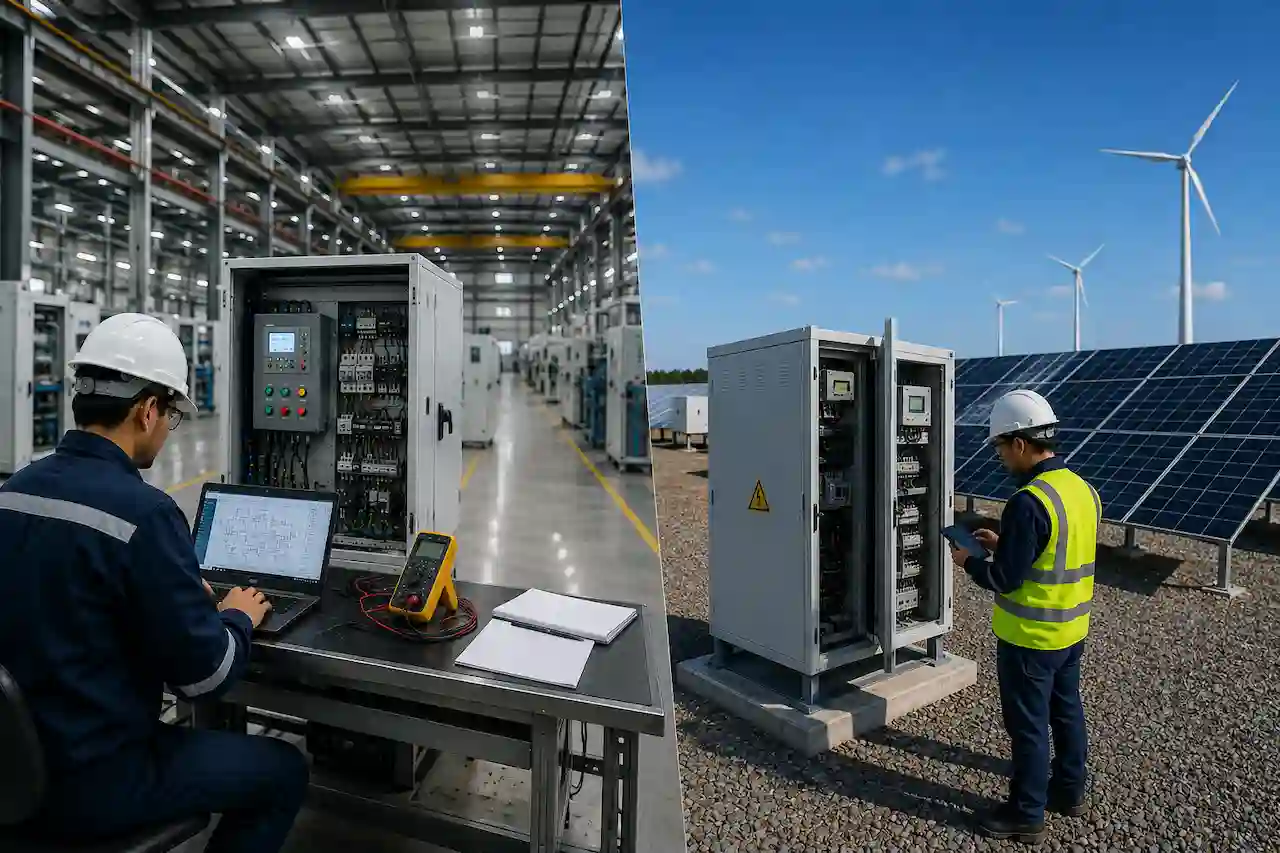
Renewable energy projects involve multiple stages of engineering, construction, testing, and commissioning before a plant can begin commercial operation. Testing plays an important role throughout this process because electrical and control systems must be verified before they are placed into service. Two terms that frequently appear during project delivery are Factory Acceptance Testing (FAT) and Site Acceptance Testing (SAT).
Although both are designed to verify that equipment and systems meet project requirements, they take place at different stages and serve different purposes. FAT is generally completed before equipment leaves the manufacturer or supplier, while SAT takes place after installation at the project site. Understanding the difference between FAT vs SAT testing can help EPC contractors, project owners, and engineering teams plan testing activities more effectively and reduce problems during commissioning.
What Is Factory Acceptance Testing?
Factory Acceptance Testing, commonly known as FAT, is performed before equipment is delivered to the project site. The purpose of FAT is to verify that equipment has been manufactured, configured, and tested according to the approved project requirements.
Depending on the project, FAT may apply to equipment such as protection and control panels, SCADA systems, plant controllers, switchgear, communication systems, and other electrical or automation equipment. For projects involving complex substations and high-voltage equipment, FAT requirements should also align with the wider substation design engineering requirements.
Testing is usually performed at the manufacturer’s facility with representatives from the supplier, EPC contractor, owner, or engineering team participating in the process. The exact scope depends on the equipment and project requirements. A FAT may verify areas such as:
Need Engineering Support for Your Power Project?
American Power Engineers delivers power system studies, substation design, renewable energy engineering, BESS projects, NERC compliance, MEP engineering, and POI interconnection services.
Explore Our Engineering Services- Equipment configuration
- Control logic
- Protection functions
- Communication interfaces
- SCADA signals
- Alarms and indications
- Hardware functionality
- Documentation and drawings
The objective is to identify problems before the equipment is transported and installed. Finding an issue at the factory is usually easier to manage than discovering the same problem after equipment has been installed at a renewable energy project.
What Is Site Acceptance Testing?
Site Acceptance Testing, or SAT, takes place after equipment has been delivered and installed at the project location. The purpose of SAT is to confirm that the equipment continues to operate correctly within the actual project environment. Equipment may pass FAT successfully but still experience problems after installation. Transportation, installation errors, field wiring issues, incorrect connections, configuration changes, or communication problems can all affect system performance. SAT helps identify these issues before the project moves into later commissioning and energisation activities. Site testing can involve verification of:
- Physical installation
- Field wiring
- Communication connections
- Equipment configuration
- Control functions
- Protection circuits
- SCADA integration
- Interfaces with other systems
SAT therefore focuses on how the equipment performs after it becomes part of the wider project.
FAT vs SAT Testing: The Main Difference
The main difference between FAT and SAT is where and when the testing takes place.
| Testing Stage | FAT | SAT |
|---|---|---|
| Location | Manufacturer or supplier facility | Project site |
| Timing | Before equipment delivery | After installation |
| Main purpose | Verify equipment before shipment | Verify equipment in the site environment |
| System scope | Individual equipment or packaged systems | Installed equipment and site interfaces |
| Typical focus | Configuration, functionality, and design requirements | Installation, wiring, integration, and operation |
| Result | Equipment approved for shipment | Equipment approved for further commissioning |
Both testing stages are important. FAT cannot completely replace SAT because equipment must still be verified after installation. Similarly, relying only on SAT can increase project risk because major issues may not be discovered until equipment is already on site.
Why FAT Is Important for Renewable Energy Projects
Renewable energy projects often involve complex systems supplied by multiple manufacturers. A solar farm, wind farm, or battery energy storage project may include equipment from different suppliers that must eventually operate together. FAT provides an opportunity to verify equipment before it reaches the site. This can reduce the risk of discovering major manufacturing or configuration problems during the final stages of construction.
Planning a Solar, Wind, BESS, or Grid Interconnection Project?
Our engineering team helps project owners, developers, utilities, and facility teams move from technical planning to reliable project execution.
View Engineering ServicesIdentifying Problems Before Delivery
One of the main benefits of FAT is early problem identification. For example, a protection panel may contain incorrect relay settings, or a SCADA system may have missing signals in its database. Identifying these problems before shipment gives the supplier time to correct them in a controlled environment.
If the same problem is discovered after installation, the project team may need to coordinate site access, specialist engineers, additional testing, and equipment modifications. This can create unnecessary delays.
Verifying Approved Engineering Requirements
FAT also helps confirm that the supplier has built and configured equipment according to approved engineering documentation. Testing may compare the completed system against:
- Approved drawings
- Functional design specifications
- Protection settings
- Point lists
- Communication requirements
- Control philosophies
This creates an important checkpoint before the equipment becomes part of the construction and commissioning process.
What Is Typically Tested During FAT?
The scope of FAT depends on the equipment. However, renewable energy projects commonly require testing across electrical protection, control, automation, and communication functions.
Protection and Control Panels
For protection and control equipment, FAT may include verification of relay configuration, control logic, alarms, indications, and trip functions. Engineers may also check whether the panel wiring matches the approved drawings. Communication between intelligent electronic devices may also be tested before shipment. The objective is to confirm that the equipment is ready for site installation.
SCADA and Control Systems
SCADA systems often require extensive FAT because they involve large numbers of data points, alarms, measurements, and control functions that must support reliable grid interconnection engineering and plant operation. Testing may include checking that signals are correctly displayed and that commands operate as intended. The engineering team may also verify communication protocols and system interfaces. For larger projects, the FAT may include simulated inputs to confirm how the system responds under different operating conditions.
Plant Controllers
Plant controllers are particularly important in renewable energy facilities because they may manage active power, reactive power, voltage, and other plant-level functions. FAT can help verify control logic before the controller is installed at the site. However, complete verification may not be possible until the controller communicates with actual plant equipment and external interfaces. This is one reason SAT and later integrated commissioning remain essential.
Why SAT Is Important After Installation
Once equipment arrives at the project site, it becomes part of a much larger system. The equipment must be installed correctly and connected to other electrical and control systems. SAT confirms that these site conditions have not introduced new problems.
Verifying Physical Installation
Before detailed functional testing begins, the commissioning team may inspect the equipment installation. This can include checking equipment condition, connections, cable terminations, and other installation requirements. The purpose is to confirm that the system is physically ready for testing. Problems introduced during installation may not have been present during FAT.
Checking Field Wiring and Connections
Field wiring is one of the major areas that must be verified during SAT. An equipment panel may have passed FAT successfully but still fail to operate correctly because of an incorrect field connection. Testing helps confirm that inputs and outputs are connected to the correct devices. This becomes particularly important for protection systems and remote control circuits.
Verifying Communication at the Project Site
Communication systems must also be tested after installation. A device may have communicated correctly during FAT but fail to connect to the wider site network. The commissioning team must verify that equipment is communicating through the correct network paths. This can include connections between protection relays, SCADA systems, plant controllers, inverters, meters, and remote interfaces.
How FAT and SAT Work Together

FAT and SAT should not be viewed as separate activities with no connection between them. They are part of a wider testing and commissioning process. FAT focuses on identifying problems before delivery, while SAT confirms that the equipment works correctly after installation. A successful FAT can make SAT more efficient because many basic equipment problems should already have been resolved. However, SAT introduces new testing requirements because the equipment must now interact with real site conditions. A practical testing sequence often follows this general process:
- Equipment design and configuration
- Factory Acceptance Testing
- Equipment delivery
- Site installation
- Site Acceptance Testing
- Pre-commissioning
- Integrated system testing
- Energisation
- Functional testing and project handover
The exact sequence may vary depending on the project and equipment involved.
FAT vs SAT in Renewable Energy Commissioning
Renewable energy commissioning requires coordination between several engineering disciplines. Accurate power system studies also provide important engineering information for protection, control, and equipment testing requirements. Electrical, protection, SCADA, control, communication, and grid engineering activities often overlap. FAT can help verify individual systems before they arrive at the site. SAT then confirms that those systems operate correctly after installation. However, neither stage alone confirms that the complete renewable energy plant is ready for energisation. The project must also undergo integrated testing.
For example, a protection relay may pass FAT and SAT individually. However, the complete protection scheme must still be verified with field wiring, circuit breakers, control systems, and SCADA interfaces.
Similarly, a plant controller may pass factory testing but require additional verification once connected to actual inverters and grid interfaces. The complete commissioning process therefore moves from individual equipment verification toward full system integration.
Common Problems Identified During FAT
FAT can identify a wide range of issues before equipment reaches the project site. Common examples include:
- Incorrect equipment configuration
- Missing or incorrect signals
- Protection setting errors
- Incorrect control logic
- Communication mapping problems
- Wiring discrepancies
- Missing alarms
- Documentation errors
Finding these problems early can reduce the amount of corrective work required during site commissioning. However, FAT quality depends on having clear test procedures and approved engineering documentation. Testing against outdated drawings or incomplete requirements can create problems that continue into later project stages.
Common Problems Identified During SAT
SAT focuses on issues that may only become visible after installation. These can include field wiring errors, damaged connections, network problems, configuration changes, and integration failures. Some common issues include:
- Incorrect cable terminations
- Communication failures
- Network configuration problems
- Incorrect signal mapping
- Equipment configuration changes
- Control circuit failures
- Missing interfaces between systems
SAT helps identify these problems before the project moves toward energisation. A structured SAT process also creates evidence that important equipment and functions have been verified.
Challenges When FAT and SAT Are Poorly Planned
Poor planning can reduce the value of both FAT and SAT. Several issues can affect the testing process and create problems later during commissioning, including:
- Uncontrolled configuration changes: If equipment configuration changes between FAT and site installation, the SAT team needs to understand what has changed and whether additional testing is required.
- Treating FAT as a simple formality: Important issues may remain undiscovered if the correct engineering specialists are not involved.
- Unclear testing responsibilities: Failing to define which tests should be completed at the factory and which should take place at the site can lead to gaps in testing.
- Assuming FAT completes all testing: Some functions cannot be fully verified until the equipment is connected to the actual project systems.
- Poor documentation control: Changes made after FAT must be properly recorded and reviewed to ensure the site team is working with current information.
How EPC Teams Can Improve FAT and SAT Testing
A structured approach can make FAT and SAT more effective. The following practices can help improve the testing process.
Define Testing Requirements Early
Testing requirements should be developed during the engineering stage. The project team should clearly define which systems require FAT, what the test procedures should cover, and who is responsible for witnessing or approving the results.
Early planning gives suppliers enough time to prepare the equipment and test environment.
Use Approved and Current Documentation
Test procedures should be based on the latest approved engineering documents. This can include drawings, point lists, protection settings, communication architectures, and functional specifications.
Using outdated documentation can result in equipment passing tests against requirements that are no longer valid.
Record and Close Issues Properly
Issues identified during FAT or SAT should be recorded clearly. Each issue should include the problem description, responsible party, corrective action, and closure status.
Important issues should be retested after corrective work has been completed. This provides better visibility throughout the commissioning process.
Maintain Clear Handover Between FAT and SAT
The results of FAT should be available to the site commissioning team. This helps engineers understand what has already been tested and which issues were identified.
A clear handover also helps prevent unnecessary repetition while ensuring that important site-specific tests are not missed.
The Role of Specialist Engineers During FAT and SAT

FAT and SAT can involve several engineering disciplines, depending on the equipment and systems being tested. Different specialists may be involved at different stages, including:
- Protection engineers for relay and protection panel testing
- SCADA engineers for communication and control system verification
- Electrical commissioning engineers for equipment installation and functional testing
Specialist engineers add value by understanding the technical requirements behind each test. Their role is not limited to confirming that a checklist has been completed.
When unexpected results occur, they can investigate whether the problem is related to equipment configuration, engineering design, wiring, communication, or system integration. This becomes particularly valuable when multiple suppliers are involved and responsibilities overlap.
A coordinated engineering approach can help identify problems that fall between different contractor responsibilities and support faster resolution before the project moves to the next stage.
Preparing for Successful Energisation
FAT and SAT are important steps before plant energisation, but they form part of a wider commissioning process.
Before energisation, the project team must confirm that electrical systems, protection functions, control systems, and safety requirements are ready. For grid-connected facilities, this readiness should also support the technical requirements established during the grid interconnection engineering process. The results from previous testing stages should support this decision, while any outstanding issues should be reviewed carefully to determine whether they could affect safe operation.
The objective is to move into energisation with confidence that critical systems have been tested at both the equipment and site levels. A well-managed FAT and SAT process can reduce last-minute problems and provide a stronger foundation for final commissioning.
Need Support with FAT and SAT Testing for Renewable Energy Projects?
FAT and SAT testing require careful coordination between equipment suppliers, EPC teams, and specialist engineers. Grid Engineering Group provides engineering support for renewable energy projects across commissioning, protection and control, SCADA integration, and power systems engineering.
Our team can help identify technical issues early, coordinate system interfaces, and support testing activities as projects move toward energisation and commercial operation.For project owners who require independent technical oversight during critical testing and commissioning stages, owner’s technical advisory services can provide additional engineering support.
Contact Grid Engineering Group to discuss your renewable energy project and engineering requirements.
Frequently Asked Questions
What is the difference between FAT and SAT testing?
FAT is performed at the manufacturer’s or supplier’s facility before equipment is delivered. SAT is performed after the equipment has been installed at the project site.
Is SAT required if equipment has passed FAT?
Yes. FAT verifies equipment before shipment, while SAT confirms that the equipment operates correctly after installation and connection to site systems.
What equipment requires FAT in renewable energy projects?
FAT may be performed on protection panels, SCADA systems, plant controllers, switchgear, communication equipment, and other complex electrical or control systems.
What is checked during SAT?
SAT can include equipment installation, field wiring, communication connections, control functions, protection circuits, and system interfaces.
Can FAT replace commissioning testing?
No. FAT is only one stage of the testing process. Equipment must still undergo site testing, integrated system testing, and other commissioning activities before energisation.
Why is FAT important for EPC projects?
FAT helps EPC teams identify equipment and configuration problems before delivery. This can reduce the risk of major corrective work and delays during site commissioning.
Work With American Power Engineers
Expert engineering support for power system studies, substation design, renewable energy projects, BESS engineering, NERC compliance, MEP engineering, and POI interconnection services.
Explore All Engineering Services