
Gas-Insulated Substation Design: Engineering Guide for Modern HV/EHV Applications
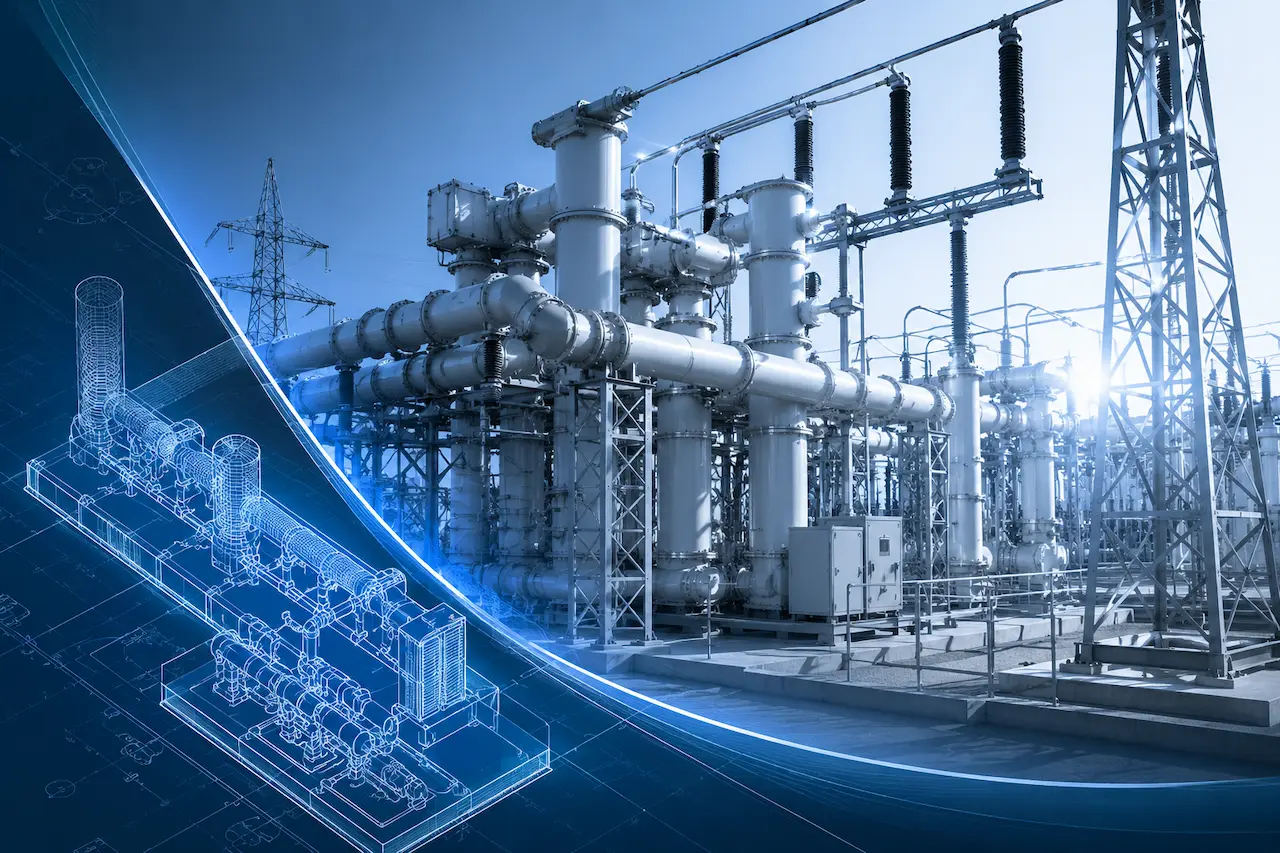
Gas-insulated substations (GIS) represent the pinnacle of high-voltage substation engineering compact, reliable, and capable of operating in environments where conventional air-insulated designs are impractical.
Understanding when GIS is the right choice, how to design it correctly, and what operational considerations distinguish it from AIS is essential for engineers and owners working at transmission voltages.
The GIS Advantage: Why SF6 Gas Changes Everything
Sulfur hexafluoride (SF6) gas at elevated pressure (typically 3-7 bar absolute) has dielectric strength approximately 2.5 times that of air at atmospheric pressure. This dramatic improvement in insulation capability is what allows GIS to achieve footprints 5-15% of equivalent AIS at the same voltage level.
At 500 kV, an AIS substation may require 10,000+ square meters of yard area to maintain required phase clearances. A GIS substation at the same voltage level can fit in a fraction of that space sometimes under 1,000 square meters for the primary equipment.
IEEE C37.123: The GIS Design Standard
IEEE C37.123-2016, the Guide for Specifications for Gas-Insulated, Metal-Enclosed Switchgear for Rated Voltages Above 52 kV, is the primary standard governing GIS specification and design in North America. Key provisions include:
Need Engineering Support for Your Power Project?
American Power Engineers delivers power system studies, substation design, renewable energy engineering, BESS projects, NERC compliance, MEP engineering, and POI interconnection services.
Explore Our Engineering ServicesType Testing Requirements: GIS equipment must be type-tested to demonstrate performance under dielectric, current-carrying, and mechanical loading conditions. Type test certificates from recognized testing laboratories are required for major equipment procurement.
Routine Testing Requirements: Each GIS unit manufactured must pass defined routine tests to verify quality before delivery. These include dielectric testing (AC withstand and partial discharge tests), mechanical operation tests, and gas leak tests.
Pressure Testing and Gas Monitoring: GIS enclosures must be pressure-tested and equipped with SF6 density monitors (not pressure gauges) that alarm and trip the equipment when gas density falls below minimum safe levels.
Interlocking Requirements: GIS switching devices must have mechanical and electrical interlocks to prevent dangerous operating sequences (e.g., energizing a disconnector under load).
GIS Applications in Renewable Energy Projects
GIS is increasingly used in renewable energy applications where:
Urban Interconnection Substations: Connecting solar or wind generation to urban transmission systems where land cost is extremely high
Planning a Solar, Wind, BESS, or Grid Interconnection Project?
Our engineering team helps project owners, developers, utilities, and facility teams move from technical planning to reliable project execution.
View Engineering ServicesOffshore Wind Substation Platforms: Offshore wind farms use GIS almost exclusively because of the space constraints of offshore platform design and the corrosive marine environment
Underground Transmission Terminations: Where transmission lines transition from overhead to underground cable, GIS is often used for the termination and sectionalizing equipment
High-Altitude Sites: At high altitudes, air density reduction lowers the dielectric strength of air, potentially requiring larger AIS clearances. GIS eliminates this dependency entirely.
For renewable energy projects requiring GIS, our Substation Design & Engineering include complete GIS specification, procurement support, and installation oversight.
Environmental Considerations: The SF6 Challenge
SF6 is a powerful greenhouse gas with a Global Warming Potential (GWP) of approximately 23,500 times that of CO2 over a 100-year horizon. Despite its very low emission rates from well-maintained GIS equipment, the electricity industry faces increasing regulatory pressure to reduce SF6 use.
Several major switchgear manufacturers now offer SF6-free alternatives using alternative insulating gases:
- g3 gas (a mixture of fluoronitrile and CO2): Similar dielectric performance to SF6 at reduced environmental impact
- Clean Air (N2/CO2 mixtures): Lower dielectric performance than SF6 but zero global warming potential; requires larger equipment or higher operating pressure
These alternatives are available at transmission voltages up to 170 kV today, with development work underway for higher voltage levels. Our team stays current on SF6 alternative technology developments to advise clients on future-proofing their substation investments.
Final Thoughts
Gas-insulated substations aren’t a universal upgrade over air-insulated designs — they’re the right answer for a specific set of constraints: tight urban sites, offshore platforms, high-altitude locations, and underground cable terminations where AIS clearances simply don’t fit. Where those constraints exist, GIS delivers a footprint a fraction of AIS at the same voltage level, along with reduced exposure to contamination and weather.
The tradeoffs are real, though. GIS carries a higher upfront equipment cost, depends on specialized commissioning and maintenance expertise, and — with SF6 as the dominant insulating medium — sits squarely in the path of tightening environmental regulation. Owners evaluating GIS today should factor in not just IEEE C37.123 compliance, but where SF6-free alternatives like g3 gas or Clean Air technology might fit their voltage class and project timeline, since regulatory pressure on SF6 is only going in one direction.
Getting GIS design right comes down to matching the technology to the site constraints, specifying to IEEE C37.123 correctly, and building a gas-monitoring and maintenance strategy from day one rather than as an afterthought. Projects that skip this upfront diligence tend to pay for it later in commissioning delays or unplanned outages.
FAQs
What’s the main difference between GIS and AIS substations?
GIS uses pressurized SF6 (or SF6-alternative) gas as the insulating medium inside sealed metal enclosures, while AIS relies on ambient air and physical clearance distances for insulation. This lets GIS achieve a footprint of roughly 5–15% of an equivalent AIS design at the same voltage level.
Is GIS more expensive than AIS?
Generally, yes — GIS equipment and enclosures carry a higher upfront capital cost than comparable AIS equipment. That cost is often offset by significant land savings, reduced civil works, and lower exposure to weather and contamination, particularly in high-value or space-constrained sites.
What standard governs GIS design in North America?
IEEE C37.123-2016 is the primary standard, covering type testing, routine testing, pressure testing, SF6 density monitoring, and interlocking requirements for gas-insulated, metal-enclosed switchgear rated above 52 kV.
Why is SF6 gas becoming a regulatory concern for GIS?
SF6 has a Global Warming Potential roughly 23,500 times that of CO2 over a 100-year horizon. Even though well-maintained GIS equipment has very low emission rates, regulators are increasingly restricting SF6 use, which is driving adoption of alternatives like g3 gas and Clean Air (N2/CO2) technology.
Are SF6-free GIS alternatives ready for utility-scale transmission projects?
They’re available today for voltages up to 170 kV, with g3 gas offering dielectric performance close to SF6 and Clean Air offering zero global warming potential at the cost of larger equipment or higher operating pressure. Development for higher voltage classes is ongoing, so applicability depends on the project’s voltage level.
Why is GIS the default choice for offshore wind substations?
Offshore platforms have severe space constraints and a highly corrosive marine environment, both of which GIS handles far better than AIS. This is why GIS is used almost exclusively for offshore wind substation platforms.
Does GIS make sense for a typical solar or wind interconnection substation?
Not always. GIS tends to make sense for urban interconnection points, high-altitude sites, offshore platforms, and underground cable terminations. For a standard greenfield land-based site with no major space or altitude constraints, AIS is often still the more cost-effective choice.
GIS Substation Design Services | Substation Design & Engineering
Work With American Power Engineers
Expert engineering support for power system studies, substation design, renewable energy projects, BESS engineering, NERC compliance, MEP engineering, and POI interconnection services.
Explore All Engineering Services