
MOD-025, 026, and 027 Explained: Understanding Generator Model Validation Requirements
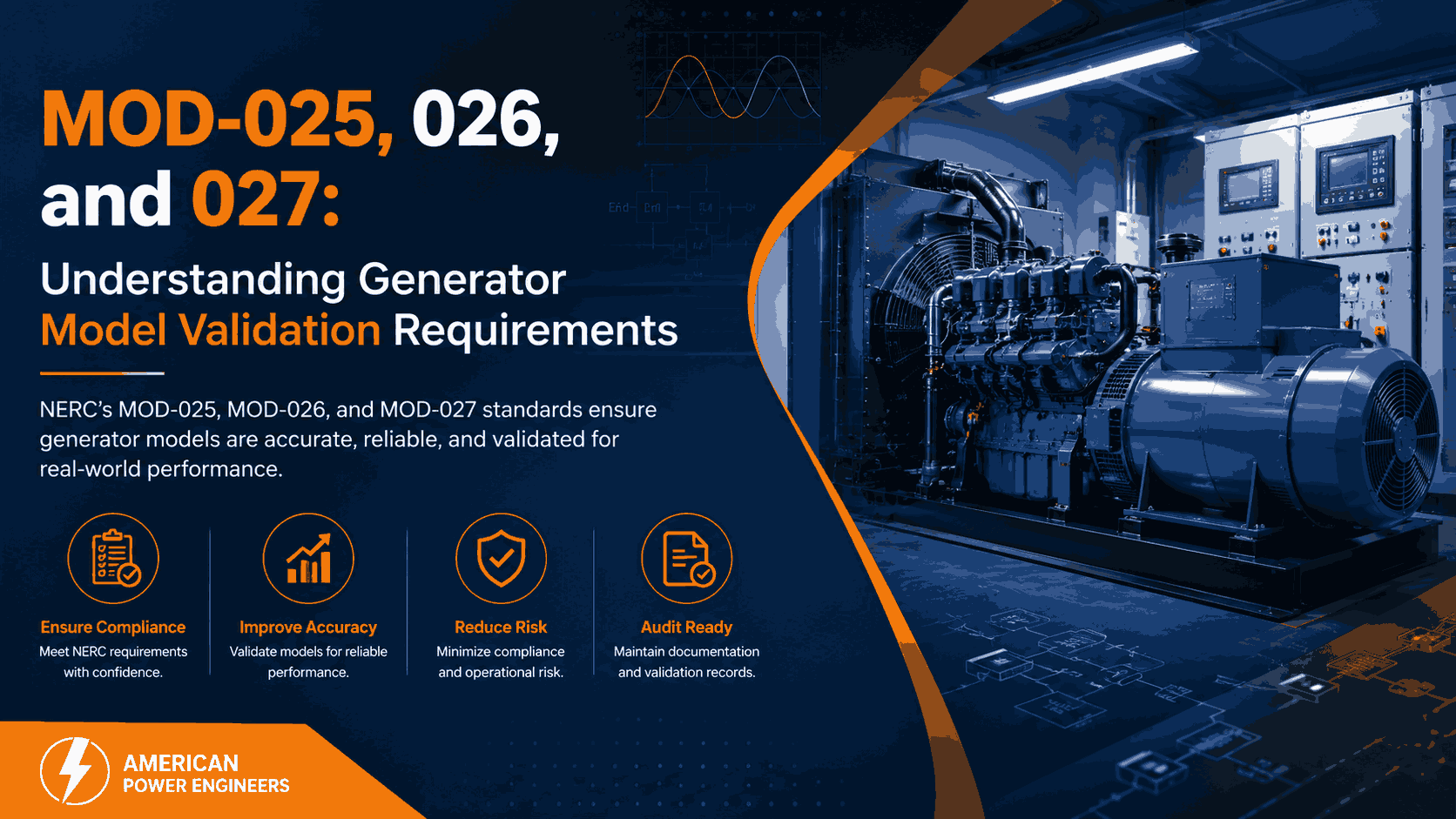
If you own or operate a generating facility on the Bulk Electric System, you have probably run into three standards that seem to overlap, reference each other, and change names mid-project: MOD-025, MOD-026, and MOD-027. Generator Owners frequently ask the same questions which standard applies to their unit, what testing is actually required, why MOD-027 is being retired, and what MOD-026-2 changes for 2026 through 2029.
This guide breaks down MOD-025, 026, and 027 in plain terms, explains how the recent MOD-026-2 consolidation affects your compliance obligations, and walks through the practical problems Generator Owners run into when scheduling, testing, and documenting generator model validation.
What Are MOD-025, MOD-026, and MOD-027?
All three standards sit within NERC’s MOD (Modeling, Data, and Analysis) family and exist for one reason: the models Transmission Planners use to simulate the grid must actually match how your generator behaves in real life.
A model built on nameplate assumptions or outdated parameters can misrepresent how a unit responds to a fault, a frequency excursion, or a voltage swing and that misrepresentation can cascade into flawed planning studies across an entire Interconnection.
| Standard | What It Verifies | Applies To |
| MOD-025-2 | Real and reactive power capability (gross and net) | Synchronous generators, synchronous condensers |
| MOD-026 | Excitation control system / Plant Volt-VAR function models | Synchronous and inverter-based generation |
| MOD-027 | Turbine/governor and active power/frequency response models | Synchronous and inverter-based generation |
MOD-025-2 remains a standalone standard. MOD-026 and MOD-027, however, have been restructured: MOD-026-2 now consolidates MOD-026-1 and MOD-027-1 into a single standard, and MOD-027-1 is being retired as part of that transition. We’ll cover what that means for your compliance calendar below.
Need Engineering Support for Your Power Project?
American Power Engineers delivers power system studies, substation design, renewable energy engineering, BESS projects, NERC compliance, MEP engineering, and POI interconnection services.
Explore Our Engineering ServicesMOD-025-2 Explained: Verifying Real and Reactive Power Capability
MOD-025-2 requires Generator Owners to verify and report the gross and net real power capability and reactive power capability of their generating units and synchronous condensers, so Transmission Planners have accurate capability data for BES reliability studies.
Key points Generator Owners need to know:
- New units must be verified within 12 calendar months of their commercial operation date.
- Existing units that have been in long-term shutdown for more than five years without testing must be re-verified within 12 calendar months of returning to service.
- Verification can be based on staged testing or operational data, and documentation must include the date and time of the verification period, ambient correction data, and generator step-up (GSU) transformer ratios and losses if measurements are taken from the high side.
- Data is submitted using the MOD-025 Attachment 2 form (or an equivalent Generator Owner form with the same information) to the Transmission Planner.
Because MOD-025-2 relies heavily on documented test data rather than dynamic simulation, it’s often the standard Generator Owners underestimate — until an audit asks for evidence tying a specific capability claim to a specific dated test.
MOD-026 Explained: Excitation and Volt/VAR Model Verification
MOD-026 addresses whether your excitation control system or plant Volt/VAR control function model including the power system stabilizer and impedance compensator models accurately represents how your unit actually responds during dynamic simulations.
Under the legacy MOD-026-1 standard, this applied primarily to synchronous machines. The revised MOD-026-2 standard significantly widens that scope to also cover inverter-based resources (IBRs), HVDC systems, and FACTS devices, reflecting how much solar, wind, and battery storage capacity has entered the BES since the original standard was written.
MOD-027 Explained: Turbine/Governor and Frequency Response Verification
MOD-027 verifies the turbine/governor and load control, or active power/frequency control model essentially, whether your unit’s real power response to a system frequency deviation matches what the model predicts. For conventional synchronous generation this means turbine/governor response; for inverter-connected generation it means active power/frequency control performance.
Planning a Solar, Wind, BESS, or Grid Interconnection Project?
Our engineering team helps project owners, developers, utilities, and facility teams move from technical planning to reliable project execution.
View Engineering ServicesMOD-027-1 is being retired, not because frequency response verification is going away, but because it is being folded directly into the new MOD-026-2 framework alongside excitation verification creating one standard instead of two.
Why NERC Consolidated MOD-026 and MOD-027 into MOD-026-2
The consolidation traces back to Project 2020-06 and, more directly, to FERC Order No. 901. NERC’s Inverter-Based Resource Performance Task Force found that MOD-026-1 and MOD-027-1 had significant modeling gaps for IBRs gaps that contributed to real disturbance events, including the Odessa, Texas incidents, where IBR fleets behaved differently than their models predicted during grid faults.
MOD-026-2 responds to those gaps by requiring:
- Verified EMT (electromagnetic transient) models, not just positive-sequence models, for applicable facilities
- Real-code fidelity benchmarked against OEM device tests, rather than generic vendor templates
- Explicit rejection of black-box models — model structure, data, and control logic must be submitted in closed-loop format
- Coverage of protection and limiting functions that act on voltage, frequency, or current and could trip a unit or limit its output during a disturbance
- Standardized, region-specific frequency-deviation thresholds for qualifying disturbance events used in verification
One detail worth flagging for ERCOT-connected assets specifically: MOD-026-2 lowers the qualifying frequency-deviation threshold from 0.10 Hz to 0.08 Hz for the ERCOT and Western Interconnections (and from 0.05 Hz to 0.04 Hz for the Eastern Interconnection), which makes it somewhat easier to capture a qualifying event for disturbance-based validation.
If your fleet sits in ERCOT, PJM, or another region where interconnection-specific study requirements already shape your engineering scope, our team can help align MOD-026-2 evidence with what your Transmission Planner and market operator expect see our ERCOT interconnection services for how we support that coordination alongside model validation work.
MOD-026-2 Compliance Timeline: Key Dates
MOD-026-2 was Board-adopted on October 31, 2025, filed with FERC on November 4, 2025, and approved by FERC on February 19, 2026, with an effective date of April 1, 2026. Compliance is phased:
- April 1, 2027 — Requirements R1 and R7 become mandatory (12 months after the effective date)
- April 1, 2029 — Requirements R2 through R6 become mandatory (36 months after the effective date)
- January 1, 2030 — Full implementation target, aligned with the broader FERC Order No. 901 work plan
This phased approach gives Generator Owners time to plan testing, but the lead time is shorter than it looks once you factor in OEM coordination, disturbance recorder installation, and outage scheduling which is where most compliance programs actually run into trouble.
Common Problems Generator Owners Face with MOD-025/026/027 Compliance
Problem: Waiting for a qualifying disturbance event
Dynamic disturbance recorder (DDR)-based validation depends on capturing a real system event that meets the frequency-deviation threshold. Continuous monitoring over roughly six months has historically been enough to catch a usable event in some regions, but that’s not guaranteed and it eats directly into your compliance runway if you start late.
Problem: OEMs won’t release real-code EMT models
MOD-026-2 pushes hard for EMT models benchmarked against actual device behavior, not generic templates. Many equipment vendors are still building out this capability, which means Generator Owners need to start OEM conversations well before a filing deadline, not after.
Problem: Submitted models get rejected as “black-box.”
Transmission Planners are required to review submissions and reject models that don’t include usable structure, data, and control logic. A rejection triggers a formal response clock (90 to 180 days depending on the circumstance), so a preventable rejection can consume months of your compliance timeline.
Problem: Treating MOD and interconnection study requirements as separate obligations.
Many ISO/RTO regions layer their own generator data requirements on top of MOD-025/026/027 — and generator owners who plan for these separately often end up going back to their testing vendor twice, at double the cost. Coordinating MOD compliance with your interconnection and planning study obligations from the start avoids duplicate testing.
Problem: Facility modifications invalidate an existing model.
Requirement R4 under MOD-026-2 requires updated models whenever a facility is modified or upgraded — a step that’s easy to miss if model validation isn’t built into your change management process. For background on how MOD standards fit into the broader compliance picture, see our complete guide to NERC compliance.
How to Build a Compliant Generator Model Validation Program
- Confirm applicability. Determine which units meet BES inclusion criteria and which standard(s) apply based on generator type (synchronous vs. IBR) and your registered functional entities.
- Build a compliance calendar. Map MOD-025-2 verification windows, MOD-026-2 phased deadlines (2027 and 2029), and any regional planning-process deadlines onto one schedule.
- Engage OEMs early. Secure real-code EMT models, factory test data, or hardware-in-the-loop test support well ahead of your filing window.
- Coordinate DDR installation and outage planning. Disturbance-based validation needs monitoring equipment in place before a qualifying event occurs, not after.
- Submit in closed-loop, non-black-box format. Include model structure, parameters, and control logic exactly as MOD-026-2 requires to avoid a rejection cycle.
- Tie model updates to your change management process. Any facility modification should automatically trigger a model resubmission review.
- Retain evidence. Keep dated submittal records, Transmission Planner correspondence, and test data for the full period since your last compliance audit.
Since regulatory obligations under MOD-025/026/027 sit alongside the broader NERC standards landscape covering FAC, PRC, and CIP requirements, it helps to understand how these categories interact our FERC vs. NERC guide explains where enforcement authority sits and why these standards carry real financial consequences for noncompliance.
FAQs
What is the difference between MOD-025, MOD-026, and MOD-027?
MOD-025-2 verifies a generator’s real and reactive power capability. MOD-026 verifies the excitation control system or plant Volt/VAR model. MOD-027 verifies the turbine/governor or active power/frequency response model. MOD-026 and MOD-027 are being consolidated into a single standard, MOD-026-2.
Is MOD-027 still an active NERC standard?
MOD-027-1 is being retired as part of the MOD-026-2 consolidation. Its frequency-response verification requirements are now incorporated directly into MOD-026-2, so Generator Owners should track MOD-026-2’s phased deadlines rather than MOD-027-1’s original schedule.
Does MOD-026-2 apply to solar, wind, and battery storage?
Yes. Unlike the earlier MOD-026-1 standard, which focused mainly on synchronous generation, MOD-026-2 explicitly expands applicability to inverter-based resources, along with HVDC systems and FACTS devices.
How often do generator models need to be re-verified?
Periodicity depends on the requirement and interconnection, but re-validation on a roughly five-year cycle is common in several regions, in addition to triggers like facility modifications or extended shutdowns.
What happens if a Transmission Planner rejects a submitted model?
The Generator Owner or Transmission Owner must respond within 120 calendar days of a rejection notice, or within 180 calendar days if the request stems from an identified model or documentation deficiency, unless a revised timeline is mutually agreed upon.
When does MOD-026-2 become fully enforceable?
MOD-026-2 became effective April 1, 2026. Requirements R1 and R7 are mandatory starting April 1, 2027, while Requirements R2 through R6 become mandatory April 1, 2029, with full implementation targeted for January 1, 2030.
Can aggregate models be used for smaller generating units?
Yes, for units under 20 MVA within a generating plant, MOD-026-2 permits aggregate modeling rather than requiring individual unit-level models, provided the aggregate representation reflects the facility’s dynamic behavior at the point of interconnection.
Why Partner With American Power Engineers for Generator Model Validation
Generator model validation sits at the intersection of field testing, dynamic modeling, and regulatory documentation and getting any one piece wrong can trigger a model rejection or a compliance gap. American Power Engineers supports Generator Owners through the full MOD-025/026/027 lifecycle:
- Applicability review across MOD-025-2, MOD-026-2, and legacy MOD-027-1 obligations
- Dynamic model development and validation for synchronous and inverter-based generation
- Coordination with OEMs to secure real-code EMT models and supporting test data
- Evidence package development aligned with Transmission Planner submittal requirements
- NERC O&P compliance support, including audit readiness and documentation review
Explore our NERC O&P 693 Compliance Services for a closer look at how we support the technical foundation of your compliance program.
Contact American Power Engineers: Contact Form | Email: info@americanpowerengineers.com
Related Services:
- NERC O&P 693 Compliance Services
- POI Interconnection Engineering
- Power System Studies
- Utility-Scale Solar Farm Engineering
- Utility-Scale Wind Farm Engineering
- Utility-Scale BESS Engineering
Related Reading:
Work With American Power Engineers
Expert engineering support for power system studies, substation design, renewable energy projects, BESS engineering, NERC compliance, MEP engineering, and POI interconnection services.
Explore All Engineering Services