
PRC-019 Coordination Studies: What Auditors Actually Look For
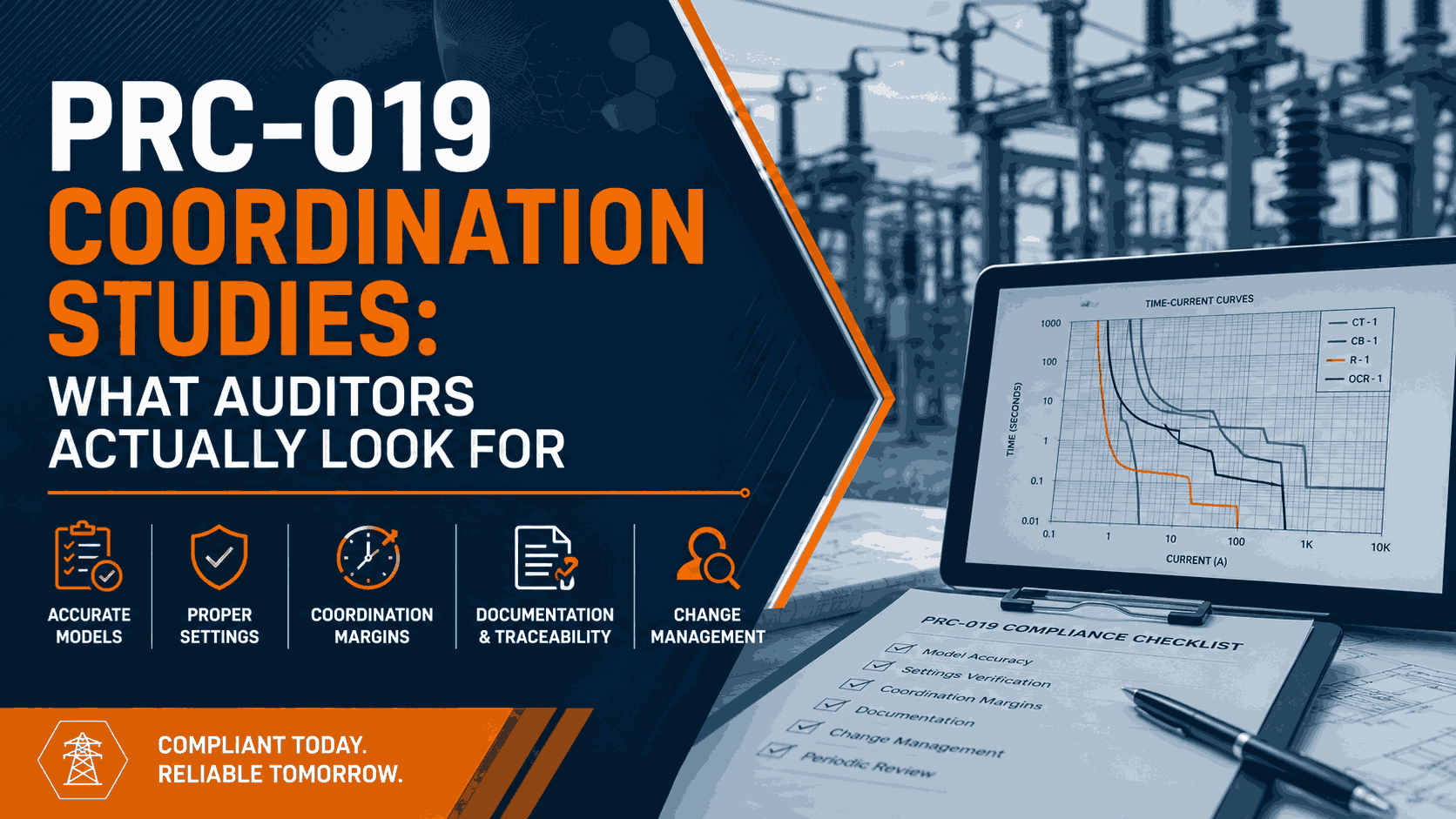
Most generator owners don’t fail a NERC audit because their voltage regulating controls are actually miscoordinated. They fail because they can’t produce evidence proving the coordination in a form the auditor can independently verify. Understanding PRC-019 audit requirements before the audit notification letter arrives not after is the difference between a clean audit and a mitigation plan.
PRC-019-2 sounds simple on paper: coordinate your voltage regulating system controls, limiters, and protection functions so limiters act before protection trips the unit. In practice, it’s one of the more frequently misunderstood PRC standards, largely because the standard itself doesn’t tell you how to demonstrate coordination, it only tells you that you must. That gap is exactly where audit findings happen.
This guide breaks down what PRC-019 actually requires, what auditors ask to see, and where compliance packages typically fall apart.
What PRC-019 Actually Requires
PRC-019-2’s stated purpose is to verify coordination of generating unit or synchronous condenser voltage regulating controls, limiter functions, equipment capabilities, and Protection System settings so that a generator isn’t unnecessarily tripped off the Bulk Electric System during a disturbance.
The standard traces back to lessons from the 1996 Western Interconnection outages and the 2003 Northeast blackout, where uncoordinated generator protection contributed to cascading trips.
Need Engineering Support for Your Power Project?
American Power Engineers delivers power system studies, substation design, renewable energy engineering, BESS projects, NERC compliance, MEP engineering, and POI interconnection services.
Explore Our Engineering ServicesThe standard has two operative requirements:
- R1 — At a maximum of every five calendar years, each Generator Owner and Transmission Owner with applicable Facilities must coordinate voltage regulating system controls (including in-service limiters and protection functions) with the applicable equipment capabilities and Protection System settings. In-service limiters must be set to operate before protection trips the unit.
- R2 — Within 90 calendar days of a system, equipment, or setting change that affects that coordination including voltage regulating setting changes, Protection System changes, generator capability changes, or GSU transformer changes the coordination review must be redone.
That 90-day trigger under R2 is where a lot of entities get caught off guard. A relay setting change made during a routine maintenance outage, an excitation system firmware update, or a GSU transformer replacement all reset that clock whether or not anyone flagged it as a compliance event.
Who PRC-019 Applies To
The applicability threshold is broader than most owners assume:
- Individual generating units greater than 20 MVA (gross nameplate) directly connected to the BES
- Individual synchronous condensers greater than 20 MVA
- Generating plants/facilities on a common bus with aggregate generation greater than 75 MVA — this includes dispersed power producing resources (wind and solar) captured under Inclusion I4 of the BES definition
- Any blackstart unit designated in a Transmission Operator’s restoration plan, regardless of size
That aggregate 75 MVA threshold is what pulls smaller wind and solar sites into scope even when no individual inverter or turbine exceeds 20 MVA on its own a detail that trips up developers who assume PRC-019 is a “big synchronous generator” standard.
What Auditors Actually Look For
Auditors aren’t grading your excitation system design. They’re checking whether your evidence package proves independently, without needing your engineers to explain it verbally that the required coordination exists and was reviewed on schedule.
Based on how PRC-019 evidence is evaluated during audits, self-certifications, and spot checks, four things consistently get scrutinized:
Planning a Solar, Wind, BESS, or Grid Interconnection Project?
Our engineering team helps project owners, developers, utilities, and facility teams move from technical planning to reliable project execution.
View Engineering Services1. Coordination Plots That Actually Show Margin
NERC’s implementation guidance for PRC-019-2 points to specific plot types as expected evidence: P-Q diagrams, R-X diagrams, and inverse time characteristic plots showing capability curves, limiter thresholds, and protection settings on the same graphic.
Auditors want to see the actual margin between where a limiter activates and where protection would trip not just a narrative statement that “coordination was confirmed.” A plot with limiter and protection curves crossing, or sitting too close together with no documented margin, is a direct path to a finding.
2. Dated, Retained Evidence Covering the Full Cycle
PRC-019-2 requires six years of evidence retention for R1 compliance. Auditors will ask for the study that was current at each point in your five-year cycle, not just your most recent one. If your last coordination study is undated, references settings that no longer match your relay database, or can’t be tied to a specific revision of the excitation system settings, that’s a documentation gap even if the underlying engineering was sound.
3. Evidence That R2 Triggers Were Actually Tracked
This is the single most common finding. Auditors will cross-reference your maintenance records, relay setting change logs, and capital project history against your PRC-019 coordination dates. If a protection setting changed 14 months ago and there’s no coordination review dated within 90 days of that change, you have an R2 gap regardless of whether the new settings happen to still be coordinated. Auditors are checking for a process that catches these triggers, not just a lucky outcome.
4. Consistency Between the Study and What’s Actually In Service
The coordination study has to reflect limiters and protection functions that are actually in service and activated, not what’s nameplate-capable or what was originally specified. If a limiter was disabled during commissioning and never re-enabled, or a relay setting was changed in the field without updating the study, the study no longer represents reality.
Auditors increasingly request corroborating evidence relay setting sheets, SCADA screenshots, or commissioning records alongside the coordination plots themselves.
Where PRC-019 Compliance Packages Fall Apart
A few patterns show up repeatedly across PRC-019 findings and near-misses:
- Inverter-based resources treated like an afterthought. For IBR facilities with plant-level voltage control, coordination has to trace from the point of origin of voltage regulating control down to the individual inverter including Qmax, Qmin, Pmax, Pmin, and frequency limiter functions at the plant controller level. Entities that only study the plant controller and skip individual inverter-level protection often can’t defend the study under questioning.
- Using contractual limits instead of actual capability. NERC guidance is explicit that artificial capability limitations — like a POI interconnection agreement cap — shouldn’t be substituted for the unit’s or plant’s actual maximum output capability when performing the coordination analysis.
- No internal process for flagging R2 events. Relay technicians and excitation vendors don’t always know a setting change has PRC-019 implications. Without a documented change-management trigger tied into compliance tracking, R2 windows get missed silently.
- Regional interpretation differences. WECC, NPCC, and other Regional Entities have issued their own guidance and, at times, interpret ambiguous provisions of PRC-019 differently. A study built for one region’s audit expectations doesn’t always transfer cleanly if your fleet spans multiple Regional Entities or interconnection queues a common scenario for developers building across ERCOT, WECC, and MISO territory; see our ERCOT interconnection services for how POI-level coordination is handled through the interconnection process itself.
Building a Defensible PRC-019 Evidence Package
A coordination study that will hold up under audit scrutiny generally includes:
- Capability curve documentation — generator or plant capability at nominal and off-nominal voltage, sourced from OEM data, not assumed nameplate values.
- Limiter and protection settings, cross-referenced to actual relay/AVR configuration — not the design intent, the as-left settings.
- P-Q, R-X, or time-characteristic coordination plots showing limiter activation clearly ahead of protection operation, with margin explicitly called out.
- A dated coordination summary with pass/fail determination for each coordination item required under R1.1.
- A documented R2 tracking mechanism tied to your broader change management process, so setting or equipment changes automatically flag a PRC-019 review.
- Six years of retained, version-controlled prior studies, so you can reconstruct what was coordinated and when, even years after the fact.
Building this out for a mixed fleet synchronous units, legacy hydro with limited OEM documentation, and newer IBR sites is where most internal compliance teams need outside engineering support, particularly when original excitation or inverter documentation is incomplete and curves have to be reconstructed from first principles.
How This Connects to Broader NERC Protection Compliance
PRC-019 doesn’t sit in isolation. It’s frequently audited alongside PRC-024 (frequency and voltage protective relay settings) and PRC-025 (generator relay loadability), since all three standards govern when and whether generator protection should operate during system disturbances.
If you’re building out a broader compliance program, our PRC-024-4 frequency and voltage protection guide and MOD-026-2 model validation guide cover the adjacent standards that auditors typically review in the same cycle. For a fleet-wide view of applicability and program structure, our complete NERC compliance guide is a useful starting point.
Why Work With American Power Engineers on PRC-019
American Power Engineers builds PRC-019 coordination studies backed by the same engineering depth used in our protection coordination and interconnection work — not compliance paperwork produced without underlying analysis. Our support includes:
- Full-scope PRC-019 coordination studies for synchronous generators, synchronous condensers, and inverter-based resources
- P-Q, R-X, and time-characteristic coordination plotting using PSS/E, DIgSILENT, and equivalent tools
- Reconstruction of capability and limiter curves for legacy units with incomplete OEM documentation
- R2 trigger tracking integrated with your change management and maintenance records
- Audit-ready documentation packages structured around what compliance auditors and Regional Entities actually request
Our team also supports the broader O&P standard family — see our NERC O&P 693 Compliance Services for gap analysis, evidence build-out, and mock audit support across FAC, PRC, and TPL standards.
Contact American Power Engineers: Contact Form | Email: info@americanpowerengineers.com
FAQs
What are the basic PRC-019 audit requirements?
Auditors expect dated coordination studies showing limiter activation ahead of protection operation, retained for six years, along with evidence that any R2-triggering setting or equipment change was re-coordinated within 90 calendar days. Evidence must reflect actual in-service settings, not design values.
How often does PRC-019 coordination need to be performed?
At a maximum of every five calendar years under R1. That cycle resets sooner — within 90 calendar days — any time a voltage regulating setting, Protection System setting, generator capability, or GSU transformer change affects the coordination, under R2.
Which facilities are subject to PRC-019?
Individual generating units or synchronous condensers over 20 MVA directly connected to the BES, generating plants with aggregate capacity over 75 MVA (including qualifying wind and solar facilities), and any blackstart unit designated in a Transmission Operator’s restoration plan.
What evidence do auditors expect to see for PRC-019?
Coordination plots (P-Q, R-X, or inverse time characteristic) showing limiter and protection curves with clear margin, a dated coordination summary, and documentation tying the study to actual as-left relay and AVR settings — not nameplate or design assumptions.
What’s the difference between PRC-019 and PRC-024?
PRC-019 focuses on coordinating a generator’s voltage regulating controls, limiters, and protection so limiters act before protection trips the unit. PRC-024 sets frequency and voltage ride-through requirements for protective relays to prevent unnecessary tripping during system disturbances. They’re related but evaluate different aspects of generator protection and are often audited together.
Does PRC-019 apply to solar and wind facilities?
Yes. Dispersed power producing resources captured under Inclusion I4 of the BES definition are explicitly included when aggregate plant capacity exceeds 75 MVA. For plant-level voltage control, coordination has to extend from the plant controller down to individual inverter or turbine-level protection.
What triggers a PRC-019 R2 re-coordination review?
Any voltage regulating setting or equipment change, Protection System setting or component change, generating or synchronous condenser capability change, or GSU transformer change that affects the coordination described in R1. The review is due within 90 calendar days of the change.
Work With American Power Engineers
Expert engineering support for power system studies, substation design, renewable energy projects, BESS engineering, NERC compliance, MEP engineering, and POI interconnection services.
Explore All Engineering Services