
SCADA Commissioning for Renewable Energy Projects: What EPC Teams Need to Know

Renewable energy projects depend on more than electrical equipment operating correctly. Once a solar farm, battery energy storage system, wind project, or other generating facility approaches energisation, the different systems across the plant must be able to communicate, exchange information, and respond correctly to operational commands. This is where SCADA commissioning becomes a critical part of the project.
A SCADA system provides operators with visibility and control over important parts of a renewable energy plant. It can collect measurements, display equipment status, communicate alarms, record events, and allow authorised control actions to be performed. For EPC teams, however, SCADA commissioning is rarely limited to checking whether devices are connected to a network. The real challenge is confirming that information moves correctly across the complete system. Field devices, protection relays, inverters, plant controllers, meters, communication equipment, and grid interfaces may all need to exchange information correctly before the project can progress through energisation and final handover.
Poor coordination during this stage can delay commissioning, create unexpected operational problems, and affect project schedules. This guide explains what SCADA commissioning renewable energy projects involve and what EPC teams need to know before plant energisation.
What Is SCADA Commissioning / SCADA commissioning renewable energy?
SCADA commissioning is the process of testing and verifying that the supervisory control and data acquisition system performs according to the approved project design. The process confirms that the SCADA system can collect the required information from plant equipment and present it correctly to operators and connected systems. Depending on the project, the SCADA system may interact with:
- Inverters or power conversion systems
- Protection relays
- Plant controllers
- Revenue and operational meters
- Substation equipment
- Weather stations
- Battery management systems
- Network switches and communication equipment
- Grid operator or remote control interfaces
The purpose of commissioning is to verify not only individual communication links but also how these systems operate together. A device may appear to be online while important data points are missing, incorrectly mapped, or displaying the wrong values. SCADA commissioning helps identify these issues before the plant enters normal operation.
Need Engineering Support for Your Power Project?
American Power Engineers delivers power system studies, substation design, renewable energy engineering, BESS projects, NERC compliance, MEP engineering, and POI interconnection services.
Explore Our Engineering ServicesWhy SCADA Commissioning Matters for Renewable Energy Projects
SCADA is an important connection between plant equipment and the people responsible for operating the facility. Operators rely on accurate information to understand the condition of equipment and respond to alarms or abnormal events. If SCADA information is incorrect or incomplete, operators may not have a clear picture of what is happening across the plant. For renewable energy projects, this can affect:
- Operational visibility
- Remote control capability
- Alarm management
- Fault investigation
- Grid interface performance
- Plant availability
SCADA problems can also affect commissioning activities directly.
For example, equipment may operate correctly in the field, but the project may not be ready for handover if the control room cannot confirm equipment status or receive the required alarms. This is why SCADA commissioning should be treated as an integrated engineering activity rather than a final software check.
The Main Stages of SCADA Commissioning
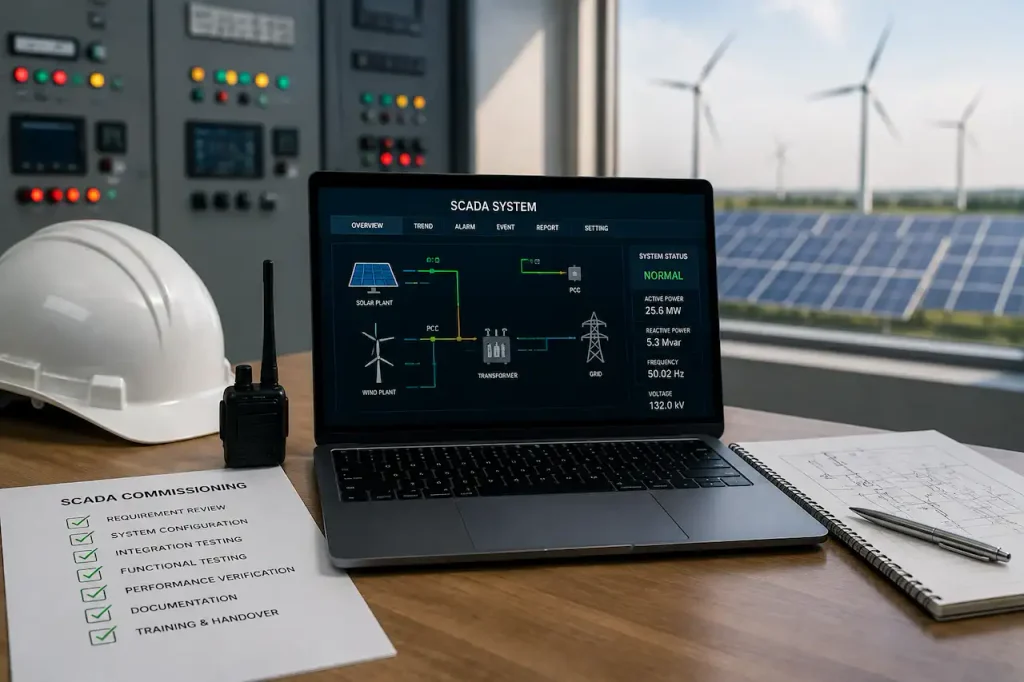
SCADA commissioning normally follows a structured process. The exact sequence depends on the project design and equipment, but several activities are commonly required before final energisation and operational handover.
Reviewing the SCADA Design and Point List
Before field testing begins, the commissioning team should review the approved SCADA design. This includes confirming what equipment is expected to communicate with the system and what information should be available. One of the most important documents is the point list or signal list. This identifies the data points that need to be exchanged between equipment and systems. Typical points may include:
- Equipment status
- Open and closed positions
- Measurements
- Alarms
- Fault indications
- Control commands
- Setpoints
A clear point list gives the EPC and commissioning teams a reference for testing. Without a properly controlled point list, teams can face confusion about whether missing information represents a fault or simply an undocumented design change.
Planning a Solar, Wind, BESS, or Grid Interconnection Project?
Our engineering team helps project owners, developers, utilities, and facility teams move from technical planning to reliable project execution.
View Engineering ServicesVerifying Communication Networks
The SCADA system depends on reliable communication between different devices. Before detailed functional testing can begin, the network infrastructure must be checked. This can include communication paths between field devices, local controllers, SCADA servers, engineering workstations, and remote interfaces.
During this stage, the commissioning team may verify:
- Device connectivity: Required devices are reachable through the intended network.
- Network configuration: Addresses and communication paths are configured correctly.
- Communication protocols: Devices are using the required protocols to exchange information.
- System interfaces: Communication between controllers, SCADA systems, and remote interfaces is working as intended.
However, successful communication alone does not confirm that the system is ready. A network connection may be active while incorrect protocols, addresses, configurations, or communication mappings prevent useful information from being exchanged. Network testing should therefore provide the foundation for later point-to-point and functional verification.
Point-to-Point Testing
Point-to-point testing is one of the most important parts of SCADA commissioning. The purpose is to confirm that a signal from field equipment is received and displayed correctly in the SCADA system.
For example, engineers may change the status of a device in the field and confirm that the correct status appears on the operator interface. The same process can be used to verify alarms, measurements, and other signals. Point-to-point testing helps identify issues such as:
- Incorrect point mapping
- Missing signals
- Incorrect engineering units
- Reversed status indications
- Incorrect alarm configuration
- Communication errors
Each signal should be checked against the approved project documentation. This process can be time-consuming on large renewable energy projects because thousands of points may need to be verified. For this reason, clear test procedures and accurate documentation are important for keeping the commissioning programme under control.
Testing Status, Alarms, and Measurements
Different types of SCADA points require different forms of verification. Equipment status information must accurately represent the actual condition of the device. If a circuit breaker is open, the SCADA system should display the correct open status. Incorrect or reversed status information can create serious operational confusion. Alarms must also be tested carefully. The commissioning team should confirm that the correct alarm is generated when the relevant condition occurs and that the alarm is displayed in the correct location. Measurements require verification of values and engineering units.
A value that appears on the SCADA screen may be incorrect because of scaling or configuration issues even when communication is functioning correctly. Testing should therefore focus on the accuracy of information rather than simply confirming that a value is displayed.
Testing Remote Control Functions
Many renewable energy plants require operators to perform authorised control actions remotely. SCADA commissioning must confirm that commands are transmitted correctly and that the intended equipment responds. Examples may include opening or closing switching equipment, enabling or disabling functions, or sending operational setpoints. Control testing requires particular care because incorrect commands can affect equipment operation. The testing process should confirm:
- The correct command is available
- Authorised users can access the command
- Required interlocks operate correctly
- The command reaches the intended equipment
- Equipment responds as expected
- The updated status is returned to SCADA
A successful control command should therefore be verified from the operator interface through to the field equipment and back again.
SCADA and Protection System Integration
Protection relays are important sources of operational information. They may provide breaker status, alarms, measurements, protection operations, and event information to the SCADA system. During commissioning, engineers need to verify that the correct protection information is available where required. This is particularly important following a protection operation. The relay may operate correctly, but if the SCADA system does not display the correct alarm or status, operators may have difficulty understanding what happened. SCADA and protection engineers should therefore coordinate their testing activities. Key checks may include:
- Relay status indications
- Protection alarms
- Trip indications
- Measurements
- Event information
- Communication status
This coordination helps confirm that electrical protection and operational monitoring work together as intended.
SCADA Integration with Plant Controllers
Renewable energy facilities often use plant controllers to manage active and reactive power, voltage control, frequency response, and other operational functions. The SCADA system may exchange information with the plant controller and provide visibility into plant operating conditions. Commissioning must verify that these interfaces work correctly.
A plant controller may receive information from multiple systems and send commands to large numbers of inverters or power conversion systems. A communication or mapping problem at this level can affect the operation of the wider plant.
Testing should therefore confirm that important operational information and control functions are correctly coordinated across the SCADA and plant control architecture.
Grid Operator and Remote Interface Testing
Some renewable energy projects require communication with external grid operators or remote control centres. These interfaces can involve measurements, equipment status, alarms, and control commands. The requirements may be defined as part of the grid interconnection engineering process. EPC teams should not leave external interface testing until the final stage of the project. Grid operator interfaces may involve separate communication infrastructure, approved point lists, and testing procedures. Delays in these activities can affect the overall energisation programme. Early coordination with the relevant parties can help identify requirements before they become a critical project issue.
Common SCADA Commissioning Problems
SCADA commissioning often reveals problems that are not visible during installation. A system can appear complete physically while configuration and integration issues remain unresolved.
- Incorrect Point Mapping: A signal may be connected to the wrong SCADA point or displayed under an incorrect equipment reference. This can create confusion during operation and fault investigation.
- Missing or Incomplete Signals: Some required data points may not have been configured or included in the final point list. This can become particularly problematic when the missing information is required for project acceptance.
- Incorrect Scaling or Engineering Units: Measurements may be communicated successfully but displayed incorrectly because of scaling or configuration errors.
- Communication Configuration Issues: Incorrect network addresses, protocols, or device configurations can prevent systems from exchanging information correctly.
- Poor Interface Coordination: Different contractors may complete their individual systems successfully while problems remain at the interfaces between those systems. This is one of the most common reasons SCADA issues appear late in the commissioning process.
How EPC Teams Can Reduce SCADA Commissioning Delays
SCADA commissioning delays often result from coordination problems rather than a single technical fault. The most effective approach is to plan the commissioning process early and define clear responsibilities. EPC teams should ensure that communication architecture, point lists, interface requirements, and testing responsibilities are understood before final commissioning begins. A practical readiness process can include:
- Confirming that the latest point list is approved
- Checking equipment communication requirements
- Reviewing interface responsibilities
- Confirming network availability
- Preparing test procedures
- Identifying external communication dependencies
- Tracking issues through to closure
The project should also avoid treating SCADA as a final activity after electrical work has been completed. SCADA integration should develop alongside electrical commissioning so that interface problems can be identified early.
The Importance of Coordinated Issue Management
During commissioning, issues are expected. The key is how efficiently they are identified, assigned, and resolved. SCADA problems can involve multiple parties. A missing point may be caused by a field device configuration, network issue, controller mapping problem, or SCADA database error. Without a structured process, teams can spend significant time debating responsibility. A clear issue management process should record the problem, identify the responsible party, track corrective action, and confirm closure through retesting. This provides better visibility for EPC project management and helps prevent the same issue from delaying later commissioning stages.
The Role of Specialist SCADA Engineers
SCADA commissioning requires an understanding of both digital systems and electrical plant operation. Specialist SCADA engineers help connect these areas. Their role can include:
- Reviewing communication architecture
- Verifying point lists and signal mappings
- Supporting point-to-point testing
- Testing alarms and control functions
- Coordinating system interfaces
- Investigating communication problems
When a signal does not appear correctly in SCADA, the cause may not be immediately obvious. The problem could be located in the field device, relay, controller, communication network, protocol configuration, or SCADA database. A systematic engineering approach helps identify the actual source of the problem rather than making assumptions based on where the issue first becomes visible.
SCADA Commissioning Before Plant Energisation
SCADA commissioning is closely connected to energisation readiness. Before the plant enters normal operation, project teams need confidence that operators can monitor critical equipment and receive the information required to manage the facility.
Not every SCADA activity may be completed at the same time, depending on the project commissioning sequence. However, critical monitoring, alarm, and control functions should be available when required for safe energisation and operation. The commissioning team should clearly identify which functions are necessary before each energisation stage. This approach helps prevent the project from reaching a critical milestone while essential system interfaces remain untested.
Need Support with SCADA Commissioning for Renewable Energy Projects?
SCADA commissioning is an important part of renewable energy project delivery. Problems with communication, signal mapping, alarms, or control functions can delay energisation and affect the transition from construction to operation. Grid Engineering Group provides specialist engineering support for renewable energy projects, including SCADA commissioning, system integration, protection and control coordination, energisation support, and power system engineering.
Whether your project is approaching commissioning or experiencing integration issues that are affecting the energisation programme, specialist engineering support can help identify interface problems and coordinate testing across the wider plant. For project owners who require independent technical oversight during commissioning and energisation, owner’s technical advisory services can help support technical coordination and critical project decisions.
Contact Grid Engineering Group to discuss your SCADA commissioning and renewable energy project requirements.
Frequently Asked Questions
What is SCADA commissioning in a renewable energy project?
SCADA commissioning is the process of testing and verifying that the supervisory control system correctly receives, displays, records, and exchanges information with renewable energy plant equipment.
What is point-to-point testing?
Point-to-point testing verifies that a signal from field equipment is correctly received and displayed at the SCADA system.
Why can SCADA problems delay plant energisation?
Critical equipment status, alarms, measurements, and control functions may be required before the plant can be safely operated. Unresolved SCADA integration problems can therefore delay commissioning milestones.
What systems are commonly connected to renewable energy SCADA?
Depending on the project, SCADA may communicate with inverters, protection relays, plant controllers, meters, substation equipment, weather stations, battery systems, and external grid interfaces.
Why is SCADA and protection coordination important?
Protection systems provide important operational information. Correct SCADA integration helps operators receive accurate status, alarms, measurements, and protection event information.
When should SCADA commissioning begin?
Planning and integration activities should begin during the engineering and construction stages rather than being left until the final phase before energisation.
Work With American Power Engineers
Expert engineering support for power system studies, substation design, renewable energy projects, BESS engineering, NERC compliance, MEP engineering, and POI interconnection services.
Explore All Engineering Services