
Substation Design Process 101: From Concept to Constructible Package
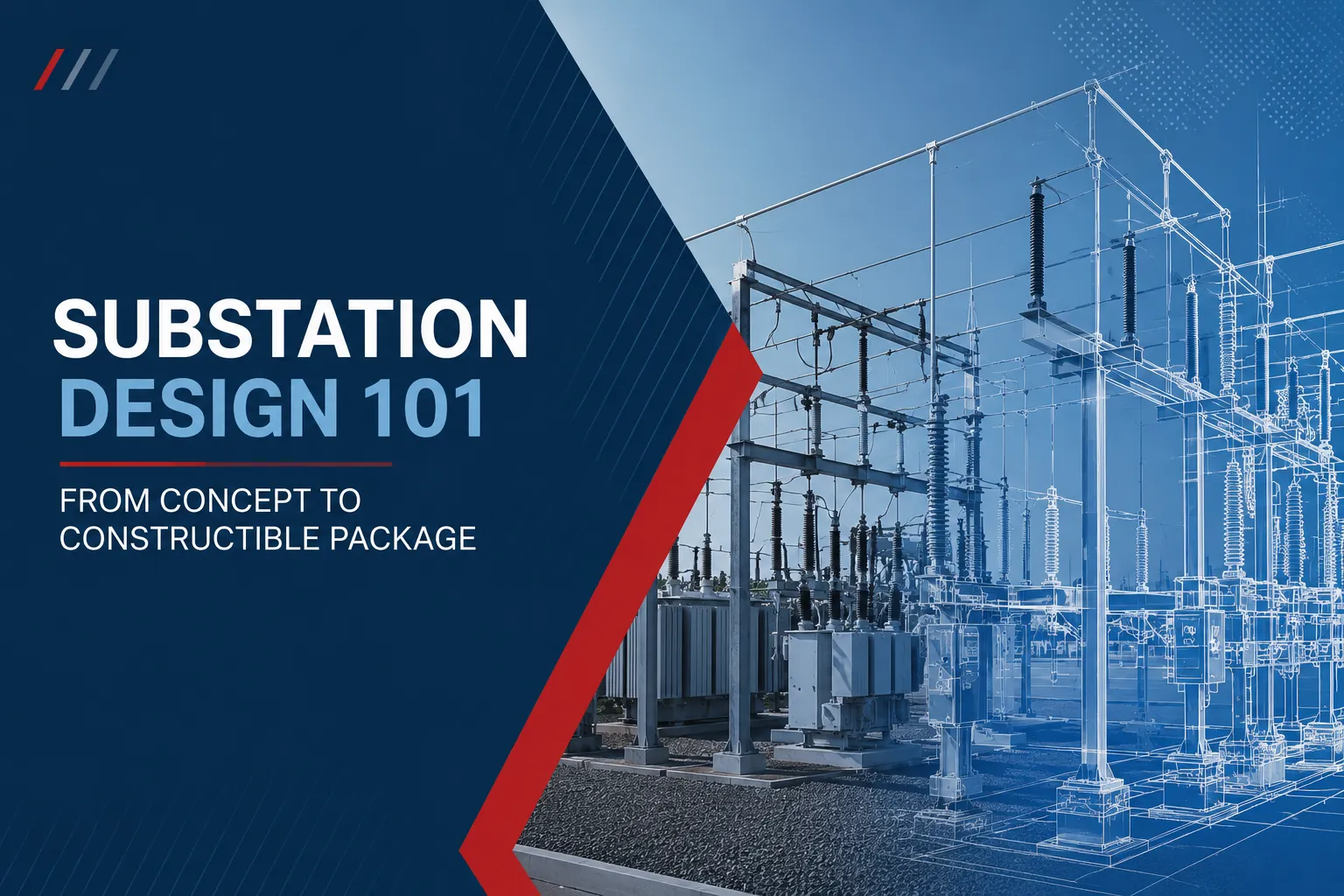
A new substation looks simple on a single line diagram, a few breakers, a transformer, some buswork. In practice, the substation design process is one of the most coordination-heavy exercises in power engineering, and it’s where a surprising number of utility-scale projects lose weeks or months they can’t get back.
The pattern is familiar to anyone who’s managed one of these projects: electrical design finishes a layout, civil comes back with a grading conflict, protection settings shift after a late-arriving short circuit study, and suddenly the “final” one-line has gone through six revisions before a single foundation is poured.
None of that is because the engineering is hard in isolation, it’s because substation design sits at the intersection of electrical, protection, civil, and interconnection requirements that all move at different speeds.
This guide walks through the substation design process the way it should actually run from scope definition through a truly constructible package and flags the points where projects typically stall, so you know what to lock down early.
If your substation is tied to a renewable interconnection, it’s worth reading this alongside our overview of POI interconnection engineering, substation design and point-of-interconnection engineering are technically distinct scopes, but they run on the same clock, and a lot of schedule risk lives in the handoff between the two.
Need Engineering Support for Your Power Project?
American Power Engineers delivers power system studies, substation design, renewable energy engineering, BESS projects, NERC compliance, MEP engineering, and POI interconnection services.
Explore Our Engineering ServicesWhy the Substation Design Process Breaks Down on Real Projects
Before getting into the steps, it’s worth naming the actual failure modes, because they’re consistent across transmission, distribution, and renewable collector substations alike:
- Scope and voltage class get “finalized” before load, fault, and interconnection data are confirmed — so the layout gets built on assumptions that shift later.
- Electrical and civil run in silos until a foundation layout collides with an equipment arrangement that changed two revisions ago.
- Protection and control design starts late, often after the physical layout is already frozen, forcing rework when relay and control requirements don’t fit the space allotted.
- Long-lead equipment (power transformers, breakers, switchgear) isn’t specified early enough, and procurement timelines end up driving the schedule instead of the design.
- “Design complete” and “construction-ready” get treated as the same milestone, when in reality a design can be electrically sound and still be unbuildable without further civil, structural, and constructability review.
A structured substation design process exists specifically to catch these failure points before they cost schedule. Here’s how it should run.
The Substation Design Process, Step by Step
1. Scope & Basis of Design
Everything downstream depends on getting this stage right. Before any layout work begins, the project needs a locked basis of design covering:
- Voltage class and bus configuration (single bus, main-and-transfer, ring bus, breaker-and-a-half, etc.)
- Owner, utility, and applicable standards (IEEE, ANSI, NESC, NEC, plus any utility-specific design guides)
- Preliminary one-line diagram reflecting expected generation, load, or collection requirements
- Site constraints — available acreage, environmental setbacks, access, and soil conditions if known
The most common problem-solving opportunity, here is simple: don’t let this stage get rushed. A basis of design that’s revisited three months into detailed engineering is the single biggest source of substation rework, because it invalidates layout, civil, and equipment decisions all at once.
2. Concept & Layout
With the basis of design set, the physical layout takes shape equipment arrangement, bus configuration, clearances, and site orientation. This is where the substation starts to look like a real facility rather than a one-line diagram: transformer pads, breaker positions, control building location, fencing, and access roads all get placed relative to each other.
Good concept layout work anticipates the next two stages rather than treating them as someone else’s problem later. That means loading in preliminary grounding grid requirements, control building cable routing, and civil grading assumptions during layout not after.
Planning a Solar, Wind, BESS, or Grid Interconnection Project?
Our engineering team helps project owners, developers, utilities, and facility teams move from technical planning to reliable project execution.
View Engineering Services3. Electrical & Protection Design
This is the detailed engineering core: relay and protection schemes, control panel design, grounding grid calculations, lightning and surge protection, and detailed one-line and three-line diagrams. Protection philosophy should be established here in coordination with the results of load flow, short circuit, and coordination studies not bolted on after layout is frozen.
If your protection and relay coordination work hasn’t already been informed by dedicated short circuit and coordination studies, that’s worth doing in parallel rather than after the fact.
Our power system studies team typically runs load flow, short circuit, and protective coordination analysis specifically to feed this stage of substation design, rather than validating it afterward.
4. Civil & Structural Coordination
Substation design fails here more often than anywhere else, because electrical and civil disciplines are solving different problems on the same site: grading, foundations, structural steel, and drainage all need to reconcile with the electrical equipment arrangement down to conduit routing and foundation embed locations.
The fix is procedural, not technical: civil and structural coordination needs to run concurrently with electrical design, with a shared, version-controlled layout, not a “throw it over the wall” handoff after electrical design is marked complete.
5. Construction Documents
At this stage, the design package needs to shift from “electrically correct” to “buildable by a contractor who wasn’t in the design meetings.” That means stamped drawings, complete specifications, bill of materials, and equipment data sheets detailed enough that an EPC or utility construction crew can execute without guessing at intent.
This is also the point where equipment lead times start to matter more than engineering hours. Power transformers, GIS equipment, and specialty breakers can carry lead times measured in months sequencing specification and procurement release against the construction document schedule is a scheduling exercise as much as an engineering one.
6. Construction Support
Design isn’t finished when drawings are issued. RFIs, submittal review, and field coordination through energization are where design intent either survives contact with the actual site or doesn’t.
Budgeting real engineering time for this phase not treating it as an afterthought is what keeps a well-designed substation from being value-engineered into something different during construction.
Where Region-Specific Requirements Enter the Process
The steps above hold regardless of geography, but the interconnection requirements layered on top of them are not one-size-fits-all. A collector substation feeding an ISO/RTO market carries different study, protection, and documentation expectations depending on the region facility rating submissions, protection settings review, and POI design coordination all look different in ERCOT than they do in PJM or MISO.
If your substation is tied to a market interconnection, it’s worth scoping that regional review early rather than discovering region-specific requirements mid-design see our ERCOT interconnection services for how that coordination typically runs, since the same substation design process above still applies, just with an added layer of transmission-owner and ISO review.
Common Reasons Substation Design Projects Run Over Schedule
Based on how these projects typically play out, the recurring delay points aren’t usually about engineering quality — they’re about sequencing and coordination:
- Basis of design locked too early, before fault current, load, or interconnection data was final.
- Protection and control design starting after layout was already frozen, forcing rework to fit relay panels and control cabling into a space not designed for them.
- Civil and electrical disciplines working from different layout revisions, discovered only during foundation design.
- Long-lead equipment specified late, so procurement, not engineering, became the schedule bottleneck.
- Facility rating and protection documentation is treated as a post-design task, instead of being built alongside the design package (this is also where substation design overlaps with FAC-008 facility ratings requirements for anything connecting to the Bulk Electric System).
FAQs About the Substation Design Process
How long does a typical substation design project take?
It varies significantly with voltage class, bus configuration, and interconnection complexity, but a mid-size transmission or collector substation commonly runs several months from basis-of-design through issued construction documents, with equipment lead times often extending the overall project timeline well beyond the design phase itself.
What’s the difference between a substation design package and a substation study?
A study load flow, short circuit, arc flash, protection coordination produces the technical inputs (fault currents, equipment ratings, relay settings) that inform the design. The design package is the physical and electrical engineering deliverable layouts, one-lines, protection schemes, and construction documents built using those study results.
Can substation design start before interconnection studies are complete?
Concept-level layout and basis-of-design work can often start in parallel, but final electrical and protection design should wait for confirmed fault current and interconnection data. This is one of the most common sources of costly rework when skipped, since preliminary numbers rarely match final study results exactly.
Who should be involved in substation design coordination meetings?
At minimum, electrical, protection and control, and civil/structural engineering, along with a project representative who can speak to interconnection or utility requirements. Projects that leave civil coordination for later in the process are the ones most likely to hit foundation-versus-layout conflicts.
What causes the most rework in substation design projects?
Changes to the basis of design after layout work has started typically driven by updated fault current data, revised interconnection requirements, or owner standard changes is the single most common source of substation design rework.
Do renewable collector substations follow the same design process as transmission substations?
Broadly yes, though collector substations for solar, wind, or BESS projects add interconnection-specific requirements (POI coordination, facility ratings submissions, and ISO/RTO-specific protection and metering standards) on top of the same core electrical, protection, and civil design steps.
Final Thoughts
The substation design process isn’t complicated in concept scope it, lay it out, engineer the electrical and protection detail, coordinate the civil interface, document it for construction, and support the build. Where projects actually lose time is in the sequencing: locking scope too early, starting protection design too late and treating civil coordination and construction support as afterthoughts rather than integrated phases.
Projects that treat this as one coordinated process rather than a relay race between disciplines consistently reach energization with fewer revisions and less field rework.
Work With American Power Engineers
American Power Engineers delivers HV/MV substation design packages coordinated across electrical, protection, control, civil, and SCADA scopes from basis-of-design through construction support for utilities, developers, and EPCs across North America.
Work With American Power Engineers
Expert engineering support for power system studies, substation design, renewable energy projects, BESS engineering, NERC compliance, MEP engineering, and POI interconnection services.
Explore All Engineering Services