
Renewable Energy Commissioning: A Complete Guide from FAT to COD

Renewable energy projects do not become operational the moment construction is complete. A solar farm, wind project, Battery Energy Storage System (BESS), or hybrid plant may have all major equipment installed, but the facility still needs to prove that its electrical, protection, control, communication, and grid connection systems work safely and correctly together. This is where renewable energy commissioning becomes critical.
Commissioning is the process of moving a project from construction into safe, reliable operation. It includes a series of planned inspections, tests, verifications, and acceptance activities that typically begin before equipment reaches the site and continue until the facility is ready for commercial operation. For many utility-scale projects, the journey includes Factory Acceptance Testing (FAT), installation and pre-commissioning, Site Acceptance Testing (SAT), energisation, functional testing, integrated testing, grid compliance activities, performance verification, and finally the Commercial Operation Date (COD).
Each stage serves a different purpose. FAT verifies equipment before shipment, while site testing confirms that equipment has been installed and integrated correctly. Energisation demonstrates whether electrical systems can safely enter service. Integrated testing proves that different systems can work together as one facility. COD then marks the point at which the project has met the contractual and operational requirements for commercial service.
This guide explains the complete commissioning journey from FAT to COD and highlights the engineering activities that can affect project schedules, energisation readiness, and long-term asset performance.
What Is Renewable Energy Commissioning?
Renewable energy substations commissioning is a structured process used to verify that a facility has been installed according to its approved design and can operate in line with technical, safety, operational, and grid connection requirements. The process may apply to:
Need Engineering Support for Your Power Project?
American Power Engineers delivers power system studies, substation design, renewable energy engineering, BESS projects, NERC compliance, MEP engineering, and POI interconnection services.
Explore Our Engineering Services- Utility-scale solar farms
- Wind energy projects
- Battery Energy Storage Systems
- Hybrid solar and BESS facilities
- Renewable energy substations
- Grid-connected inverter-based resources
- Associated high-voltage and interconnection infrastructure
Commissioning is much more than switching equipment on for the first time. A project may contain thousands of individual components, including transformers, switchgear, protection relays, inverters, power conversion systems, plant controllers, meters, RTUs, SCADA platforms, communication networks, and auxiliary systems. Each component may function correctly on its own while problems still exist in the way those systems interact.
For example, a protection relay may pass an individual test but fail to communicate correctly with another device. A plant controller may calculate the correct response but send a command to the wrong point. An inverter may operate locally but fail to respond correctly to remote control signals.
The purpose of commissioning is therefore to verify both individual equipment performance and complete system integration.
Why Commissioning Is Critical for Renewable Energy Projects
Modern renewable energy facilities are becoming increasingly complex. A utility-scale solar project may involve multiple inverter stations connected through a medium-voltage collection network to a substation and the point of interconnection. A BESS facility adds battery management systems, power conversion equipment, thermal management, fire and safety systems, and additional control layers.
All these systems must work together. A problem discovered during commissioning can delay energisation, require repeat testing, increase engineering costs, and affect the planned COD. In complex projects, an issue may also involve several different vendors, making troubleshooting more difficult.
A structured commissioning programme helps teams:
Planning a Solar, Wind, BESS, or Grid Interconnection Project?
Our engineering team helps project owners, developers, utilities, and facility teams move from technical planning to reliable project execution.
View Engineering Services- Identify installation and configuration issues before operation.
- Verify electrical and operational safety.
- Test protection and control systems.
- Confirm SCADA and communication performance.
- Verify system interfaces between different vendors.
- Support grid interconnection activities.
- Reduce risks before energisation.
- Demonstrate operational readiness before COD.
Commissioning is also important from a commercial perspective. COD is generally defined through project contracts and agreements rather than being triggered by one universal technical test. The requirements may include successful testing, energisation, grid approvals, performance demonstrations, and documentation or handover requirements.
Understanding the Complete Journey from FAT to COD

Although every project has its own design and contractual requirements, the commissioning journey usually follows a logical sequence. The process begins with planning and equipment-level testing. It then moves through site installation, pre-commissioning, electrical testing, protection and control verification, communication testing, energisation, and full-system operation.
A typical sequence includes:
- Commissioning planning and engineering review
- Factory Acceptance Testing
- Equipment delivery and installation
- Mechanical completion and pre-commissioning
- Site Acceptance Testing
- Electrical and high-voltage testing
- Protection and relay commissioning
- SCADA and communication commissioning
- Energisation readiness review
- Initial energisation
- Functional and integrated system testing
- Grid compliance and performance testing
- Commercial Operation Date
These stages are connected. A delay in one area can affect everything that follows. For example, incomplete field wiring may delay protection testing. Protection testing may delay energisation. Energisation delays can then affect SCADA testing, grid operator activities, performance testing, and ultimately COD. That is why successful commissioning depends heavily on planning and coordination.
Commissioning Planning Starts Long Before Energisation
One of the biggest mistakes on renewable energy projects is treating commissioning as a final activity that begins when construction is nearly complete. A more effective approach is to plan commissioning during the early engineering and project development stages.
The commissioning plan should outline how the project will progress from individual equipment testing to complete facility operation. It should define system boundaries, testing responsibilities, acceptance criteria, documentation requirements, energisation procedures, and key dependencies between systems.
Early planning is particularly important because renewable energy projects involve multiple stakeholders, including project owners, EPC contractors, equipment manufacturers, protection engineers, SCADA specialists, commissioning teams, and grid operators. Clear responsibilities and coordination help prevent critical activities from being missed and reduce the risk of delays as the project approaches energisation.
What Should a Commissioning Plan Cover?
The exact plan depends on the project, but it should normally address the major technical and organisational requirements for the commissioning process. Important areas include:
- System and subsystem definitions
- Testing procedures and acceptance criteria
- Roles and responsibilities
- Required engineering documentation
- Vendor testing requirements
- Energisation sequences
- Safety and permit requirements
- Grid operator coordination
- Punch list management
- Reporting and test records
- Handover requirements
The plan should also identify dependencies between activities.
For example, a plant controller cannot be fully commissioned until relevant field devices and communication systems are available. Similarly, a protection system cannot be fully verified if the associated CTs, VTs, trip circuits, and control wiring have not been correctly installed. Early planning helps prevent these dependencies from becoming last-minute surprises.
Factory Acceptance Testing: The First Major Quality Gate
Factory Acceptance Testing, or FAT, is generally performed before equipment is shipped to the project site. Its purpose is to verify that equipment has been manufactured and configured according to the project’s technical requirements. Depending on the project, FAT may cover protection and control panels, protection relays, plant controllers, SCADA equipment, RTUs, communication systems, power conversion equipment, battery systems, and other critical components. The exact scope should be defined by the equipment specifications and project requirements.
What Happens During FAT?
FAT usually combines physical inspection with functional testing. Typical activities may include:
- Visual and workmanship inspections
- Hardware verification
- Configuration checks
- Functional testing
- Input and output testing
- Alarm verification
- Interlock testing
- Control logic checks
- Communication testing
- Protection function testing
- Documentation review
The objective is to identify manufacturing, configuration, or functionality issues before the equipment leaves the factory.
Why FAT Matters
A problem found at the factory is generally easier to resolve than the same problem discovered after installation. Once equipment reaches the site, troubleshooting may require additional engineering support, vendor mobilisation, physical modifications, repeat testing, and changes to the commissioning schedule. FAT also creates a useful record of the equipment’s condition and configuration before shipment. For complex systems such as BESS, factory data can provide an important baseline for later performance and warranty discussions. However, a successful FAT does not mean that commissioning is complete. The equipment still needs to be transported, installed, connected, energised, and integrated into the complete plant.
From Factory to Site: Installation and Pre-Commissioning
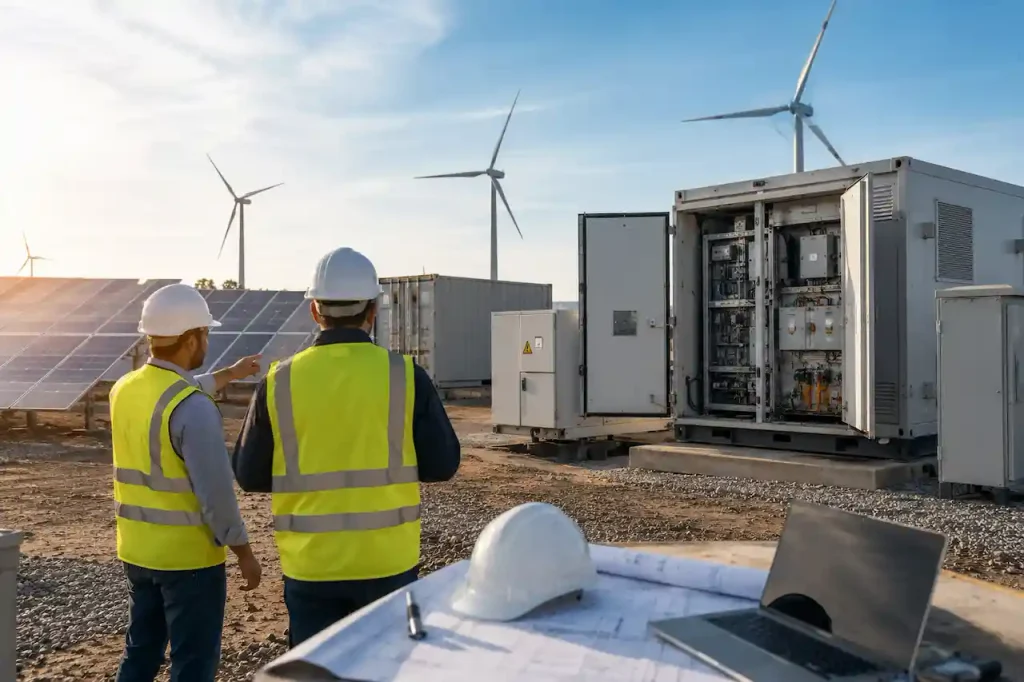
After FAT, equipment is delivered to the project site and installed according to approved engineering drawings and construction requirements. This stage may appear straightforward, but installation quality has a major impact on commissioning success. Equipment must be correctly positioned, connected, grounded, labelled, and integrated with associated electrical and communication systems.
Common installation activities include cable pulling and termination, grounding, control wiring, communication connections, equipment assembly, and verification of system interfaces. A small mistake at this stage can become a major problem later.
An incorrectly terminated cable can affect protection performance. A communication connection can prevent SCADA data from reaching the control room. Incorrect CT or VT polarity can affect measurement and protection functions. That is why projects normally move through a structured pre-commissioning stage before energisation.
Mechanical Completion
Mechanical completion generally indicates that a defined section of construction is sufficiently complete for commissioning activities to begin. However, mechanical completion does not mean that the system is ready for commercial operation. The equipment may still require electrical testing, protection testing, functional checks, communication verification, and integrated system testing.
Large projects are often divided into manageable systems and subsystems. A renewable energy facility may separate its work into areas such as the main substation, medium-voltage collection network, inverter blocks, BESS blocks, protection systems, SCADA systems, communication networks, and auxiliary systems.
This system-based approach makes it easier to track what has been completed and what still requires attention.
Managing Punch List Items
During construction and pre-commissioning, engineers and inspectors identify incomplete or defective items. These are normally recorded on a punch list. Punch list items may include missing labels, incorrect wiring, damaged equipment, incomplete documentation, communication problems, unfinished construction work, or configuration errors. Not every issue has the same level of importance.
Critical issues that affect personnel safety, electrical integrity, equipment protection, or energisation readiness should be resolved before the affected system proceeds. Minor issues may sometimes be managed separately if they do not create an operational or safety risk. The key is to maintain clear visibility.
Poor punch list management can cause significant commissioning delays because teams may repeatedly return to the same systems to resolve issues that should have been addressed earlier.
Site Acceptance Testing: Verifying Equipment in the Real Environment
Site Acceptance Testing, or SAT, takes place after equipment has been installed at the project site. While FAT verifies equipment before shipment, SAT focuses on how that equipment performs after transportation, installation, and connection to the actual project infrastructure.
SAT may apply at the equipment level or, depending on the project and contractual definitions, at a broader plant level. For this reason, teams should clearly define what SAT means for each project rather than assuming that every stakeholder uses the term in the same way.
Typical SAT Activities
SAT may include:
- Visual inspections
- Field wiring verification
- Continuity checks
- Functional testing
- Local control testing
- Remote control testing
- Alarm verification
- Interlock testing
- Communication checks
- Safety system testing
The objective is to confirm that the installed equipment is intact, correctly connected, and ready to move into the next stage of commissioning.
FAT vs SAT
The difference is simple but important.
- FAT verifies the equipment at the factory before shipment.
- SAT verifies the equipment after installation in the actual project environment.
Both stages are valuable because they identify different categories of risk. FAT cannot confirm whether equipment was damaged during transport or installed incorrectly. SAT provides the opportunity to identify these problems before the facility moves into full operation.
Electrical Testing Before Energisation
Before electrical systems are energised, the installation must be tested to confirm that it is safe and technically ready. The scope depends on the voltage level, equipment type, design requirements, manufacturer recommendations, and applicable standards. Testing may include:
- Insulation resistance testing
- Cable testing
- Continuity testing
- Transformer testing
- Switchgear testing
- Circuit verification
- Grounding checks
- CT and VT verification
High-voltage systems may require more specialised testing procedures and equipment. The goal is to identify installation defects before operational voltage is introduced.
Why Energisation Readiness Matters
Energisation is one of the highest-risk stages of the project. Once equipment becomes live, hidden problems can result in protection trips, equipment damage, electrical faults, or safety incidents.
For this reason, teams should not treat energisation as simply the next item on a construction schedule. A formal readiness review helps confirm that the required tests have been completed, critical issues have been resolved, and responsible personnel understand the energisation sequence.
Protection and Relay Commissioning
Protection systems are essential to the safe operation of renewable energy facilities. Their role is to detect abnormal electrical conditions and initiate the appropriate protective response. Protection commissioning verifies that relays, settings, wiring, logic, communication interfaces, and trip circuits operate according to the approved engineering design.
What Is Tested?
The work may include:
- Relay configuration review
- Protection settings verification
- Secondary injection testing
- Trip circuit testing
- CT and VT circuit checks
- Interlock verification
- Communication testing
- Functional protection testing
The objective is not simply to prove that an individual relay can operate. The complete protection scheme must respond correctly within the wider electrical system.
Why Protection Coordination Is Important
Different protection devices may operate under different electrical conditions. If settings are not properly coordinated, the plant may experience unnecessary trips or fail to isolate faults correctly. Potential consequences include loss of generation, equipment damage, operational instability, and longer outages. For grid-connected renewable energy facilities, protection requirements must also align with the relevant interconnection arrangements. This makes protection and relay commissioning a critical part of project readiness.
SCADA and Communication Commissioning
SCADA systems provide the monitoring and control capabilities needed to operate modern energy facilities. However, successful SCADA commissioning involves more than confirming that data appears on a screen. The complete communication chain must work correctly from field equipment through local controllers and communication infrastructure to the plant SCADA platform and, where required, remote control centres.
A typical information path may look like this:
Field Device → Controller → RTU or Gateway → Plant SCADA → Remote Control Centre
A problem at any stage can affect plant visibility or control.
Key SCADA Commissioning Activities
Testing may include:
- Status signal verification
- Analogue value verification
- Command testing
- Alarm testing
- Point-to-point checks
- Network connectivity checks
- Communication protocol verification
- Time synchronisation
- Local and remote operation testing
Common SCADA Problems
SCADA integration issues often involve incorrect point mapping, missing signals, communication protocol mismatches, network configuration errors, failed remote commands, or inconsistent time synchronisation. These problems can become particularly difficult when several vendors are responsible for different parts of the communication architecture.
Recent utility-scale project guidance also highlights SCADA and communication evidence as common sources of delays when point lists, interfaces, or network performance are not properly verified before critical commissioning milestones.
The Energisation Readiness Review
Before energising a major system, the project team should conduct a structured review. The purpose is to confirm that critical construction, testing, safety, and operational requirements have been completed. The review may consider:
- Construction completion status
- Electrical test results
- Protection test results
- SCADA and communication readiness
- Critical punch list items
- Approved energisation procedures
- Safety documentation
- Emergency procedures
- Required permits and approvals
The exact requirements depend on the project.
Energisation Usually Happens in Stages
Large renewable energy facilities are generally energised in a controlled sequence. The process may begin with auxiliary systems and progress through substations, medium-voltage infrastructure, high-voltage equipment, generation systems, and plant controls. Each project has its own energisation sequence based on the design.
Clear coordination is essential because multiple teams may be working simultaneously. Site engineers, commissioning specialists, protection engineers, SCADA teams, equipment vendors, EPC managers, and grid operators may all have responsibilities during the process.
Functional and Integrated System Testing
Once equipment is energised, commissioning moves into functional testing under live operating conditions. The objective is to confirm that systems do more than simply receive power. They must respond correctly to commands, alarms, operating sequences, interlocks, and abnormal conditions. Functional testing may examine equipment start and stop sequences, local and remote controls, protection responses, communication performance, and other operational functions. This stage provides the first opportunity to observe how individual systems behave in a live environment.
However, successful operation of individual equipment does not necessarily mean that the entire facility is ready. A renewable energy plant is an integrated power system, and its different electrical and control systems must work together correctly. Integrated system testing verifies how these systems interact. For example, a change in field conditions may be detected by monitoring equipment, processed by the plant controller, and followed by a control command to an inverter or power conversion system. At the same time, protection systems must continue to operate correctly, while SCADA records the event and provides visibility to operators.
Every part of this process must function as an integrated system. This testing is particularly important for hybrid projects where solar generation, battery storage, plant controls, protection systems, and grid infrastructure must operate together.
Grid Interconnection and Compliance Testing
Grid-connected renewable energy projects must meet the technical requirements established by the relevant transmission or distribution network. The requirements vary depending on the location, voltage level, plant capacity, technology, interconnection agreement, and grid operator.
Testing may assess active power control, reactive power capability, voltage control, frequency response, plant controller performance, protection operation, and communication with the grid operator. For inverter-based resources, control system performance can be particularly important.
Why Grid Requirements Should Not Be Left Until the End
Grid compliance is influenced by decisions made much earlier in the project. Equipment selection, control architecture, protection settings, plant controller configuration, and power system studies can all affect commissioning outcomes.
If a major issue is discovered shortly before COD, the project may require additional engineering work and repeat testing. A coordinated approach between engineering and commissioning teams helps reduce this risk.
Performance Testing
After energisation and system integration, the project must often demonstrate that it can meet defined performance requirements. The exact tests depend on the facility. A solar project may evaluate plant output, inverter operation, active and reactive power performance, and control response.
A BESS project may require additional testing related to charging and discharging capability, usable energy, power output, response time, and efficiency. Performance and capacity testing can establish important baselines for future contractual and warranty requirements. The purpose is not simply to prove that the plant can produce or store energy. The facility must demonstrate that it can operate according to its intended technical and commercial requirements.
Synchronisation and Operational Testing
For grid-connected facilities, synchronisation is another major commissioning milestone. The project must demonstrate that it can connect and operate safely with the wider electrical network. Operational testing may include active power control, reactive power control, voltage response, frequency response, plant controller behaviour, and protection system performance.
These activities often require coordination with the relevant grid operator. Because testing windows and external approvals can affect project schedules, teams should identify these dependencies early rather than waiting until the final stages of commissioning.
Commercial Operation Date: The Final Project Milestone
Commercial Operation Date, or COD, is one of the most important milestones in a renewable energy project. However, COD should not be confused with mechanical completion, first energisation, or the completion of one individual performance test.
COD is generally a contractually defined milestone. The requirements for declaring it depend on the project’s agreements and may include successful commissioning, grid connection, required performance testing, operational approvals, and formal handover requirements.
What May Be Required Before COD?
Depending on the project, the requirements may include:
- Completion of critical construction work
- Successful commissioning
- Energisation and grid connection
- Completion of required performance tests
- Resolution of critical punch list items
- Required approvals and permissions
- Completion of essential documentation
- Operational readiness
The exact criteria should always be defined by the project’s contractual and technical documentation.
Does COD Mean Everything Is Finished?
Not necessarily. Some minor punch list items, documentation activities, training, warranty tasks, and optimisation work may continue after COD. However, the systems required for safe and reliable commercial operation should be complete and functional.
Common Causes of Renewable Energy Commissioning Delays
Commissioning delays can have a direct impact on project costs and commercial timelines. One common cause is late engineering changes. A change to protection settings, equipment configuration, control logic, or interconnection requirements may trigger additional engineering and repeat testing. Incomplete construction is another major problem. Commissioning teams cannot efficiently test systems that are still being built or repeatedly modified.
Protection issues can also delay energisation. Incorrect settings, wiring errors, CT or VT problems, and communication failures may require detailed investigation. SCADA integration is another frequent challenge. Modern plants can involve hundreds or thousands of data points across multiple vendors, and unclear ownership of point lists or communication interfaces can slow progress significantly. Other common causes include incomplete documentation, equipment defects, communication failures, and poor coordination between stakeholders.
How to Reduce Commissioning Delays
Not every problem can be avoided, but strong planning can significantly reduce risk. Commissioning should begin as an engineering and project management process rather than being left until the final weeks of construction. A detailed commissioning schedule should identify critical systems, testing dependencies, vendor activities, grid operator requirements, and approval milestones. Projects should also allow realistic time for troubleshooting and repeat testing.
Dividing a facility into systems and subsystems improves visibility. Teams can track construction completion, test status, documentation, and outstanding issues for each area rather than trying to manage the entire plant as one activity. Accurate documentation is equally important. Engineers should verify that they are working from current approved drawings, protection settings, control philosophies, and communication documents.
Finally, specialist support should be involved early where projects require advanced expertise in areas such as protection and relay testing, SCADA integration, high-voltage testing, grid interconnection, or power system performance.
A Practical Renewable Energy Commissioning Checklist
Every project requires a customised commissioning plan, but the following high-level checklist provides a useful framework.
Before FAT
- Confirm technical specifications and equipment requirements.
- Prepare approved test procedures.
- Define acceptance criteria.
- Confirm documentation requirements.
During FAT
- Verify equipment functionality.
- Review configuration and control logic.
- Test relevant communication interfaces.
- Record and resolve identified issues.
Before SAT
- Confirm equipment installation is complete.
- Verify relevant mechanical completion activities.
- Ensure current drawings and documentation are available.
- Confirm field wiring is ready for testing.
During SAT
- Inspect installed equipment.
- Verify field wiring and connections.
- Test local and remote controls.
- Verify alarms and interlocks.
- Confirm communication performance.
Before Energisation
- Complete required electrical testing.
- Complete protection testing.
- Verify critical SCADA functions.
- Resolve critical punch list items.
- Approve energisation procedures and safety requirements.
After Energisation
- Complete functional testing.
- Verify integrated system operation.
- Perform required grid-related testing.
- Complete performance demonstrations.
- Confirm operational readiness.
The Value of Specialist Engineering Support
Renewable energy commissioning brings together multiple engineering disciplines. A project may require expertise in protection and control, relay testing, SCADA, high-voltage systems, power quality, grid interconnection, power system studies, and asset performance. The challenge is not simply completing a list of individual tests. The real objective is to ensure that the entire facility operates safely and reliably as an integrated power system.
Specialist engineering support can help project teams identify technical risks, investigate complex issues, review commissioning strategies, and support critical milestones such as FAT, SAT, first energisation, grid synchronisation, and performance testing. Early involvement is often more effective than waiting for a problem to appear during the final stages of the project.
How Grid Engineering Group Supports Renewable Energy Commissioning
Grid Engineering Group supports renewable energy and power system projects requiring specialist engineering expertise. Successful commissioning depends on effective coordination between electrical infrastructure, protection and control systems, SCADA, communication networks, plant controls, and grid requirements. Technical problems discovered late in the process can affect energisation schedules and commercial milestones. A structured engineering approach helps teams identify risks, verify system readiness, and investigate issues before they create larger project delays.
Whether a project involves utility-scale solar, BESS, hybrid generation, substations, or other grid-connected infrastructure, commissioning requires careful planning from early equipment testing through final operational verification. Specialist support in areas such as protection and relay testing, SCADA integration, grid engineering, high-voltage systems, and asset performance can help project teams manage the technical complexity involved in moving from construction to commercial operation.
Final Thoughts
The journey from FAT to COD is much more than a sequence of equipment tests. Renewable energy commissioning is a structured engineering process that verifies installation quality, electrical safety, protection performance, control functionality, SCADA integration, communication systems, grid interaction, and overall plant operation. FAT helps identify issues before equipment reaches the site. SAT verifies equipment after installation. Electrical and protection testing prepare systems for energisation. SCADA commissioning confirms that monitoring and control systems work correctly. Integrated testing then demonstrates whether the entire facility can operate as one coordinated system.
Finally, the project must meet its defined technical and contractual requirements before reaching commercial operation. For utility-scale solar farms, BESS facilities, wind projects, hybrid plants, and other grid-connected assets, a well-planned commissioning strategy can reduce technical risk and support a smoother path to energisation and COD. The most successful projects treat commissioning as an ongoing process that begins early, involves the right technical expertise, and continues until the facility has demonstrated that it is ready for safe and reliable operation.
Frequently Asked Questions
What is renewable energy commissioning?
Renewable energy commissioning is the process of inspecting, testing, and verifying that a renewable energy facility has been installed correctly and can operate according to its engineering design, technical requirements, safety requirements, and grid connection obligations.
What is FAT in renewable energy projects?
FAT stands for Factory Acceptance Testing. It is performed before equipment is shipped to the project site and verifies that the equipment meets defined manufacturing, configuration, and functional requirements.
What is SAT?
SAT stands for Site Acceptance Testing. It takes place after installation and verifies that equipment performs correctly in the actual project environment. The exact contractual definition and scope of SAT can vary between projects.
What happens before plant energisation?
Before energisation, teams normally complete required construction checks, electrical testing, protection testing, communication verification, safety reviews, and project-specific approval activities.
Why is protection testing important during commissioning?
Protection testing helps verify that protection systems can correctly detect abnormal conditions and initiate the required response. Incorrect settings, wiring, or coordination can create significant safety and operational risks.
What can delay renewable energy commissioning?
Common causes include incomplete construction, late engineering changes, equipment defects, protection system issues, SCADA integration problems, communication failures, incomplete documentation, and poor stakeholder coordination.
What is COD?
COD stands for Commercial Operation Date. It is a contractually defined milestone at which a project moves into commercial service after meeting the applicable technical, operational, and contractual requirements.
Need Specialist Support for Your Renewable Energy Project?
From Factory Acceptance Testing and Site Acceptance Testing to protection, SCADA, energisation, and grid integration, renewable energy commissioning requires careful coordination across multiple engineering systems.
Grid Engineering Group provides specialist engineering support for renewable energy and power system projects. Our team can help identify technical risks, support critical commissioning activities, and improve project readiness for energisation and commercial operation.
Planning a renewable energy project or approaching a critical commissioning milestone? Contact Grid Engineering Group to discuss your engineering requirements.
Work With American Power Engineers
Expert engineering support for power system studies, substation design, renewable energy projects, BESS engineering, NERC compliance, MEP engineering, and POI interconnection services.
Explore All Engineering Services