
Solar BESS Grid Integration: Key Engineering Challenges
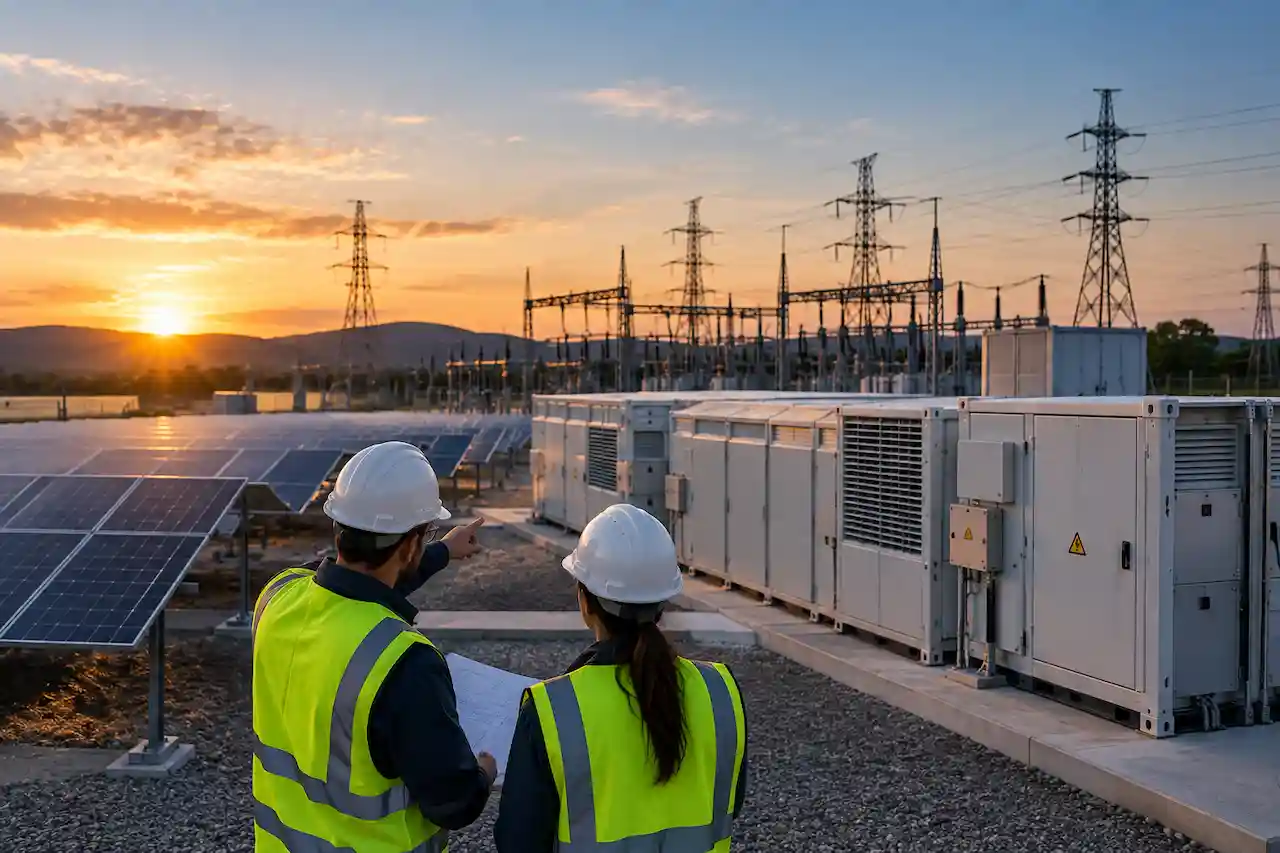
Solar generation and battery energy storage systems are increasingly developed as part of the same power system. When properly coordinated, they can improve plant flexibility, support energy shifting, and help projects meet changing grid requirements.
However, solar, BESS, and the grid cannot be treated as independent systems. Inverter controls, plant controllers, protection systems, SCADA, metering, communications, and grid interfaces must operate together as one coordinated plant.
Solar BESS grid integration therefore requires more than connecting equipment to the same substation. Project teams need to understand how the major systems interact from the inverter level through to the point of connection.
What Is Solar BESS Grid Integration?
Solar BESS grid integration is the process of connecting solar generation, battery energy storage, plant control systems, and the external electricity network so they operate together according to the approved design and grid connection requirements.
A typical hybrid project may include:
Need Engineering Support for Your Power Project?
American Power Engineers delivers power system studies, substation design, renewable energy engineering, BESS projects, NERC compliance, MEP engineering, and POI interconnection services.
Explore Our Engineering Services- Solar PV inverters
- Battery power conversion systems
- Battery management systems
- Plant power controllers
- SCADA systems
- Protection relays
- Metering systems
- Transformers and switchgear
- Communication networks
- Grid operator interfaces
These systems may be supplied by different manufacturers and contractors. Although each system may operate correctly on its own, problems can occur when they are required to work together.
The objective is to ensure that the complete plant behaves as one coordinated system.
Why Solar and BESS Integration Is Complex
Solar and battery systems both rely heavily on power electronic converters, but they perform different functions. Solar inverters convert available solar energy into electrical power. A BESS can charge, discharge, remain idle, or provide other grid support functions depending on its design and operating strategy.
When both systems operate behind the same point of connection, their controls must be coordinated. The grid sees the combined electrical behaviour of the entire facility rather than the performance of each inverter individually.
Common integration challenges include:
- Different control logic between solar and BESS systems
- Conflicting active power limits
- Uncoordinated reactive power control
- Different equipment response speeds
- Incorrect metering or signal scaling
- Protection settings that do not reflect all operating modes
- SCADA mapping errors
- Incomplete plant controller tuning
- Different grid compliance assumptions between suppliers
Many of these problems only become visible during integrated testing or commissioning. Addressing them early can reduce delays later in the project.
Planning a Solar, Wind, BESS, or Grid Interconnection Project?
Our engineering team helps project owners, developers, utilities, and facility teams move from technical planning to reliable project execution.
View Engineering ServicesThe Point of Connection Defines Plant Performance
The point of connection is one of the most important references for a hybrid solar and BESS project. Grid performance requirements are generally assessed based on how the complete facility behaves at this interface.
Requirements may include:
- Active power control
- Reactive power control
- Voltage control
- Power factor
- Frequency response
- Ramp rates
- Power quality
- Fault ride-through
- Protection performance
- Remote control
The plant may operate in several different conditions. Solar generation may be high while the BESS is charging, or solar output may be low while the BESS is discharging.
Protection, controls, and power system studies should therefore consider the full range of relevant operating modes rather than only one nominal condition.
Coordinating Plant Control
Active Power Control
Active power control becomes more complex when solar generation and battery storage operate together. The plant controller may need to determine how much power comes from the solar plant, how much the battery should charge or discharge, and how the combined output responds to grid operator commands.
For example, where an export limit applies, the controller must prevent the combined solar and BESS output from exceeding that limit.
The control philosophy may need to manage:
- Export and import limits
- Battery charging and discharging
- Solar curtailment
- Ramp-rate limits
- Dispatch commands
- Frequency response
- Energy management requirements
These responsibilities should be clearly defined before commissioning. Without a coordinated control hierarchy, separate systems may compete with each other instead of delivering the required plant response.
Reactive Power and Voltage Control
Solar inverters and BESS power conversion systems may both be capable of providing reactive power. Depending on the connection requirements, the plant may operate in voltage control, reactive power control, or power factor control.
Problems can occur when different systems attempt to regulate the same parameter independently. For example, uncoordinated control responses may result in unstable or oscillatory behaviour.
Control priorities and operating modes should therefore be clearly defined and tested at the plant level.
Battery State of Charge
Battery operation introduces another important control variable: state of charge. A BESS may be technically available but unable to provide the requested active power because it has reached an operational limit. State of charge, temperature, battery restrictions, and equipment capability can all affect performance.
The integration design should define how the plant responds when battery capability becomes constrained. This can affect dispatch, export control, frequency response, and plant availability.
Protection and Grid Compliance
Protection systems for hybrid plants must account for the combined electrical behaviour of solar and battery systems. This requires a coordinated approach to protection and wider power systems engineering. Relevant considerations may include:
- Solar and BESS inverter contribution
- Transformer and feeder protection
- Grid connection protection
- Intertripping
- Under and overvoltage protection
- Under and overfrequency functions
- Different operating configurations
A fault may occur while both systems are exporting, while the BESS is charging, or when part of the plant is unavailable. The protection philosophy should consider the relevant operating conditions.
Fault Ride-Through
Grid-connected inverter-based resources may also be required to remain connected during specific voltage or frequency disturbances. Engineering teams may need to assess:
- Voltage ride-through
- Frequency ride-through
- Reactive current response
- Active power recovery
- Protection coordination
- Controller interactions
- Post-fault plant response
Where plant-level compliance is required, the complete facility should be assessed rather than only the individual capabilities of solar or battery equipment.
Power System Studies and Model Coordination
Power system studies provide an important foundation for solar BESS integration. Depending on the project, studies may include:
- Load flow analysis
- Short circuit studies
- Protection coordination
- Harmonic analysis
- Voltage studies
- Reactive power capability studies
- Dynamic studies
- Electromagnetic transient studies
The models used for these studies should reflect the final project configuration as accurately as required. Problems can arise when supplier models are outdated, controller settings change, or the final field configuration differs from the configuration used during the original studies.
Model management should therefore continue throughout the project. Significant changes to equipment, control settings, or plant architecture may require further engineering review.
SCADA, Communications, and Metering
A hybrid project may contain thousands of operational and control points. SCADA systems provide visibility across solar equipment, battery systems, protection devices, and plant controls. Coordinating these connected systems is an important part of facility systems engineering. Important information may include:
- Active and reactive power
- Battery state of charge
- Equipment availability
- Breaker status
- Alarms
- Protection indications
- Controller operating modes
- Communication status
Common SCADA integration problems include incorrect scaling, missing alarms, reversed status indications, duplicate points, and incorrect command mapping. Point-to-point testing should verify the complete signal path from field equipment to the required control systems.
Communication Between Multiple Vendors
Solar BESS projects often involve several manufacturers, each with different communication systems and configuration methods. The integration team must clearly define how systems exchange information and who is responsible for each interface. Potential communication issues can involve:
- Protocol compatibility
- Network addressing
- Data mapping
- Timing
- Firewall configuration
- Communication failures
These issues should be addressed during engineering rather than discovered during late commissioning.
Metering Accuracy
Plant controls depend on accurate measurements. Incorrect CT or VT ratios, scaling errors, sign convention problems, or delayed measurements can affect the plant response. This is particularly important for battery systems because charging and discharging involve different power directions.
Engineering teams should verify measurement sources, scaling, power direction, sign conventions, and data quality before final commissioning.
Testing the Complete Hybrid Plant
Testing individual equipment is necessary, but it is not enough to demonstrate successful integration. The most significant problems often appear when solar, BESS, protection, SCADA, and plant controls operate together. An integrated test programme may include:
- Communication testing
- SCADA point-to-point testing
- Protection testing
- Plant controller testing
- Active power control
- Reactive power and voltage control
- Export and import limits
- Ramp-rate testing
- BESS charge and discharge operation
- State-of-charge limits
- Alarm and trip testing
- Remote commands
- Loss of communication scenarios
- Equipment availability changes
Factory Acceptance Testing can help identify issues before equipment reaches the site, while Site Acceptance Testing confirms that the installed systems operate correctly in the actual project environment. The objective is to verify the complete plant against the approved control philosophy and connection requirements.
Common Solar BESS Integration Problems
Several issues frequently appear during hybrid project commissioning.
- Different Vendor Interpretations: Different suppliers may interpret the same functional requirement differently. Clear specifications and interface documents can reduce this risk.
- Incorrect Control Priorities: Solar, BESS, and plant controllers may attempt to regulate the same parameter without a clearly defined hierarchy.
- Incomplete SCADA Point Lists: Missing or incorrectly mapped points can reduce operational visibility and delay testing.
- Protection Settings That Do Not Reflect Hybrid Operation: Protection designed around only one operating condition may not be suitable for a plant with multiple solar and BESS operating modes.
- Late Controller Tuning: Leaving plant controller tuning until late commissioning can delay performance testing and grid compliance activities.
- Model and Field Configuration Differences: Final site settings may not match those used during earlier grid studies.
Why Interface Management Is Critical
One of the greatest risks in a hybrid project is the interface between different systems and contractors. The solar supplier may be responsible for the PV inverters, while the BESS supplier manages battery controls. Another company may provide the plant controller, while separate teams are responsible for SCADA, protection, and balance-of-plant systems.
Without clear interface ownership, problems can move between contractors without being resolved. Independent owner’s technical advisory services can help project owners maintain technical oversight across complex engineering interfaces. A strong integration programme should define:
- System boundaries
- Signal ownership
- Communication responsibilities
- Control hierarchy
- Protection interfaces
- Testing responsibilities
- Documentation requirements
- Issue escalation processes
This helps turn integration into a planned engineering activity rather than a problem-solving exercise during commissioning.
Documentation and Final Commissioning
Accurate documentation is essential for a complex hybrid facility. Important documents may include:
- Single-line diagrams
- Control philosophy
- Protection philosophy and settings
- Communication architecture
- SCADA point lists
- Network drawings
- Plant controller settings
- Test procedures and reports
- FAT and SAT records
- Commissioning records
- As-built documentation
These documents should reflect the final commissioned system, including any changes made during testing. During commissioning, the engineering team should verify that equipment, protection, communications, SCADA, plant controls, and grid interfaces operate together correctly. The objective is not simply to energise the facility. It is to demonstrate that the complete plant can operate safely, reliably, and predictably.
The Role of Power Systems Integration Engineers
Solar BESS projects involve multiple engineering disciplines and suppliers, including specialist solar farm engineering and battery storage engineering requirements. Power systems integration engineers help coordinate these disciplines around the performance of the complete plant.
Their work may include:
- Interface reviews
- Power system studies
- Protection coordination
- Plant controller integration
- SCADA and communication reviews
- Test procedure development
- FAT and SAT support
- Commissioning support
- Troubleshooting
- Grid compliance support
- Documentation review
Individual systems may meet their own specifications while the complete facility still fails to deliver the required grid response. Integration engineering helps connect these individual responsibilities.
Building a Successful Solar BESS Project
Solar generation and battery storage can provide valuable flexibility, but combining them creates a more complex engineering environment.
The key challenge is coordination. Protection, SCADA, communications, plant controls, metering, battery systems, power conversion equipment, and grid interfaces must work together. The strongest projects address these interfaces during design rather than discovering them during final commissioning.
Solar BESS grid integration should therefore be treated as a complete power systems engineering task. A coordinated approach can reduce interface problems, improve commissioning readiness, and help the complete facility meet its operational and grid connection requirements.
Need Support with Solar BESS Grid Integration?
Solar and battery storage projects require careful coordination between plant controls, protection systems, communications, SCADA, metering, power conversion equipment, and grid interfaces. Grid Engineering Group provides specialist engineering support for complex renewable energy and battery storage projects, helping teams identify and manage technical interfaces before they affect commissioning and plant performance.
Whether your project is in the design stage, approaching commissioning, or experiencing integration challenges, a coordinated engineering review can help assess the complete facility and its connection requirements.
Contact Grid Engineering Group to discuss your solar BESS grid integration requirements.
Frequently Asked Questions
What is solar BESS grid integration?
Solar BESS grid integration is the process of coordinating solar generation, battery storage, control systems, protection, SCADA, communications, and the external grid so the complete facility operates according to its approved design and connection requirements.
Why is integrating solar and BESS complicated?
Solar and battery systems may use different controls, suppliers, communication systems, and operating logic. Their combined active power, reactive power, protection, and grid response must therefore be coordinated at the plant level.
What does a plant power controller do?
A plant power controller coordinates functions such as active power, reactive power, voltage, power factor, ramp rates, export limits, and other grid-related requirements.
How does BESS affect protection design?
BESS introduces additional operating modes and inverter-based electrical behaviour. Protection design should consider charging, discharging, idle conditions, and the combined behaviour of solar and battery systems.
What should be tested before commissioning?
Testing may include protection, communications, SCADA, plant controller functions, active and reactive power control, battery operation, alarms, trips, remote commands, and integrated plant operating scenarios.
Why is interface management important?
Hybrid projects often involve multiple suppliers and engineering teams. Clear interface management defines responsibilities for controls, protection, communications, testing, and documentation, helping prevent unresolved integration problems between contractors.
Work With American Power Engineers
Expert engineering support for power system studies, substation design, renewable energy projects, BESS engineering, NERC compliance, MEP engineering, and POI interconnection services.
Explore All Engineering Services