
Utility-Scale BESS Engineering Guide: Design, Interconnection & Compliance (2026)
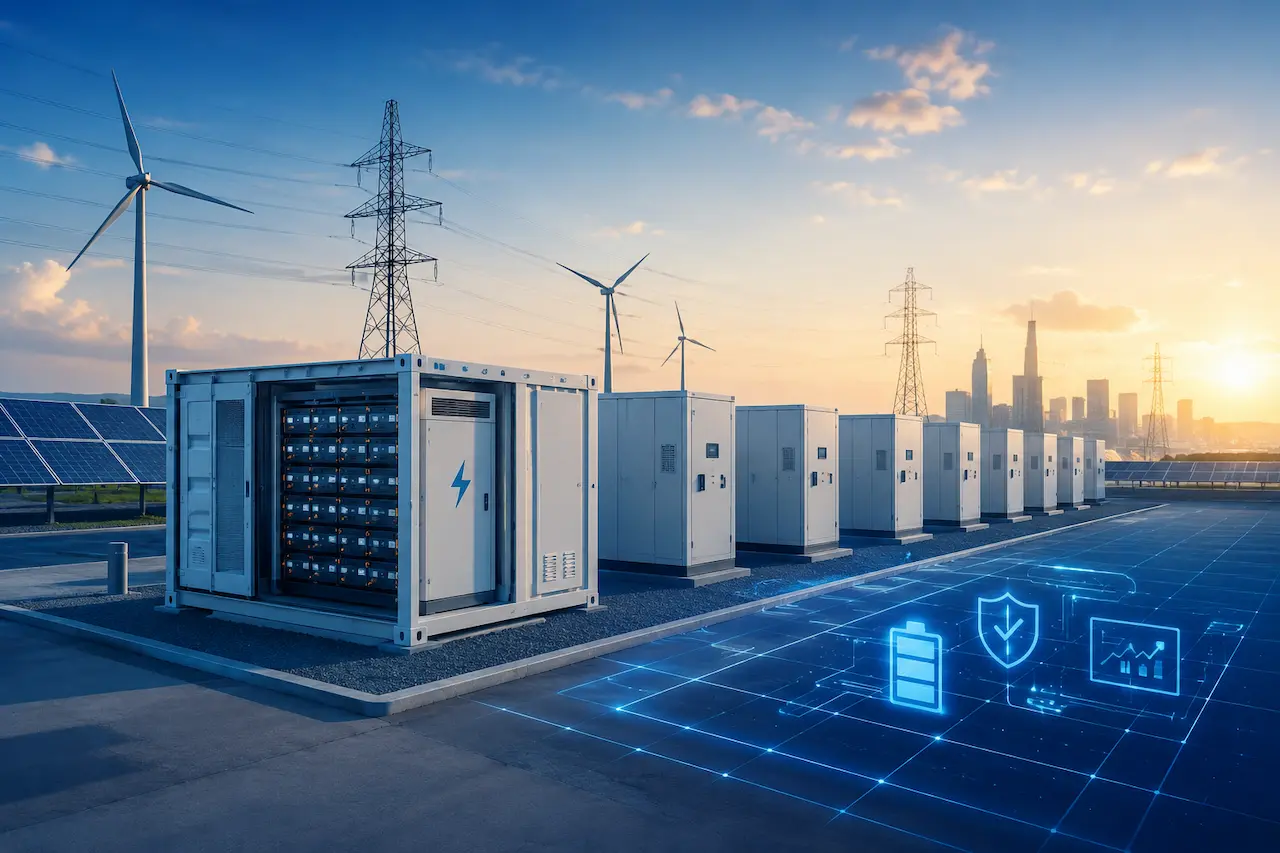
Battery energy storage systems (BESS) have moved from a niche grid application to a core piece of utility infrastructure in only a few years. Falling lithium-ion costs, rising renewable penetration that demands flexible dispatchable capacity, and growing ISO/RTO capacity market revenues have all pushed utility-scale BESS deployment into the mainstream.
But engineering a utility-scale BESS project is not as simple as procuring battery containers and wiring them to the grid. These projects involve complex power electronics, demanding thermal management, fire safety requirements, intricate interconnection studies, and a regulatory landscape that keeps shifting under the feet of developers and owners.
This guide breaks down what engineers, developers, and asset owners need to know to plan and execute a utility-scale BESS project in 2026.
What Is Utility-Scale BESS Engineering?
Utility-scale BESS engineering is the multidisciplinary process of designing, modeling, and integrating large battery storage systems (typically 10 MW and above) into the transmission or distribution grid. It spans battery chemistry selection, power conversion system (PCS) architecture, protection and interconnection studies, substation design, fire and thermal safety, and NERC/IEEE compliance all coordinated so the asset can be safely energized, dispatched, and operated for its full service life.
BESS Battery Chemistry Comparison for Utility-Scale Projects
Chemistry selection drives almost every downstream engineering decision, from footprint and fire protection strategy to expected cycle life and total cost of ownership.
Need Engineering Support for Your Power Project?
American Power Engineers delivers power system studies, substation design, renewable energy engineering, BESS projects, NERC compliance, MEP engineering, and POI interconnection services.
Explore Our Engineering Services| Chemistry | Cycle Life | Thermal Stability | Energy Density | Typical Use Case |
| LFP (Lithium Iron Phosphate) | 4,000–6,000 cycles to 80% capacity at 1C | High — low thermal runaway risk | Lower than NMC | Dominant chemistry for utility-scale, 2–4 hour duration |
| NMC (Nickel Manganese Cobalt) | Lower than LFP | Lower thermal stability | Higher | Mobile applications, some early utility-scale projects |
| Flow Batteries (Vanadium Redox, Zinc-Bromine) | Very long | High | Low | Long-duration storage (8+ hours), niche applications |
| Sodium-Sulfur (NaS) | Long | Requires high-temperature operation | Moderate | Multi-hour discharge, limited US suppliers |
Lithium Iron Phosphate (LFP) is currently the default chemistry for utility-scale applications. It offers a longer cycle life than NMC, superior thermal stability with a lower risk of thermal runaway, and broad availability from multiple US-market suppliers. Its main tradeoff is lower energy density, which means more physical footprint per MWh.
NMC delivers higher energy density but comes with reduced thermal stability. It remains more common in mobile applications and shows up in some earlier utility-scale installations.
Flow batteries (vanadium redox, zinc-bromine) decouple energy and power scaling and offer long cycle life, but at higher cost and lower round-trip efficiency than lithium-ion — making them a niche fit for long-duration storage needs of 8+ hours.
Sodium-sulfur (NaS) batteries operate at high temperature and support long cycle life and multi-hour discharge, though supplier options in the US are limited, with NEC Energy Solutions being a primary provider.
Power Conversion System (PCS) Architecture
The PCS is the piece of equipment that converts DC power from the battery racks into AC power for grid injection and its architecture shapes both performance and interconnection behavior.
- String Inverter + DC-DC Converter Architecture: Individual battery strings connect to DC-DC converters for voltage regulation, with string inverters handling DC-AC conversion. This offers highly granular control at the cost of a more complex topology.
- Central Inverter Architecture: Multiple battery strings share a common DC bus feeding a large central inverter. Simpler to design and maintain, but with less granular control per string.
- Modular Multi-Level Converter (MMC): Increasingly used in large BESS applications above 50 MW where AC-coupled architecture and high efficiency are priorities.
Chemistry and PCS architecture decisions feed directly into how the plant behaves during a fault which is exactly what interconnection studies are built to evaluate.
Planning a Solar, Wind, BESS, or Grid Interconnection Project?
Our engineering team helps project owners, developers, utilities, and facility teams move from technical planning to reliable project execution.
View Engineering ServicesBESS Interconnection Engineering
BESS interconnection follows a broadly similar path to solar and wind interconnection, but several factors are unique to storage’s bidirectional power flow:
- Reactive Capability Requirements: BESS assets must demonstrate reactive power capability across the full operating range — both while charging and discharging. The resulting Q-P capability curve looks different from that of a unidirectional generation resource, and interconnection studies need to reflect both operating modes.
- Short Circuit Contribution: Unlike synchronous generators, which contribute fault current through natural inertia, BESS inverters actively limit fault current, typically to 1.0–1.5 per unit of rated current. This behavior must be modeled correctly in short-circuit and protection studies.
- Protection Coordination: BESS projects need a protection philosophy that addresses both AC-side fault conditions and DC-side faults inside the battery banks — a more complex scope than a typical generation-only asset.
- DC Bus Protection: DC protection can’t rely on the current/voltage phasor techniques used in AC systems. Instead, it depends on different algorithmic approaches such as rate-of-change-of-current detection and differential current schemes.
Because inverter control response not physical inertia governs how a BESS behaves during a disturbance, many interconnecting utilities and ISOs are now requiring EMT-level modeling in addition to standard RMS/phasor studies to properly capture fast, control-driven dynamics.
If your project sits at a weak-grid interconnection point, it’s worth reading our guide to EMT analysis for inverter-based resources to understand when that added study scope applies.
Our POI interconnection engineering and utility-scale BESS engineering teams cover the full BESS interconnection scope, from initial system impact studies through facility study support and utility coordination.
BESS Substation Design Considerations
BESS projects introduce several design considerations that don’t show up in a typical solar or wind substation design scope:
- Pad-Mounted Transformer Selection: BESS step-up transformers must be sized for harmonic loading generated by PCS inverters, per IEEE C57.110, with a K-factor rating appropriate to the harmonic spectrum produced by the specific PCS platform.
- Fire Suppression Systems: Authority Having Jurisdiction (AHJ) requirements and insurance carrier requirements frequently mandate specific fire suppression systems for BESS enclosures. Fire suppression activation must be coordinated with electrical system de-energization sequencing.
- Thermal Management Infrastructure: Large BESS facilities typically need chilled water or HVAC infrastructure to keep batteries and PCS equipment within manufacturer-specified operating temperature ranges.
- Grounding for Ungrounded DC Systems: BESS DC systems are frequently ungrounded (isolated from earth) to improve ground-fault detection sensitivity, which means grounding design must account for an architecture that differs from conventional grounded systems.
NERC Compliance for Utility-Scale BESS
BESS facilities connected to the Bulk Electric System (BES) carry the same NERC compliance obligations as other inverter-based resources:
- NERC PRC-029-1 — Ride-through requirements applicable to BESS inverters
- NERC MOD-026-2 — Model validation requirements for BESS reactive power control systems
- IEEE 2800-2022 — Performance requirements for transmission-connected BESS
- NERC CIP — Cybersecurity standards for facilities with control systems connected to the internet or corporate networks
BESS facilities that participate in ancillary services markets — frequency regulation, spinning reserves, and similar products — also face market-specific compliance obligations, including performance testing and real-time telemetry requirements.
Our NERC O&P 693 compliance services team supports BESS owners across the full range of applicable compliance obligations, from initial gap analysis through audit preparation.
Final Thoughts
Utility-scale BESS is no longer an emerging technology it’s a mainstream grid asset with its own engineering discipline, its own interconnection challenges, and its own compliance framework. Projects that treat BESS engineering as an afterthought to procurement tend to run into costly surprises during interconnection studies, permitting, or commissioning. Getting chemistry selection, PCS architecture, interconnection modeling, substation design, and NERC compliance right from the start protects project timelines, reduces redesign risk, and supports long-term bankability.
Whether you’re early in feasibility work or deep into interconnection studies, working with a team that understands the full BESS engineering scope not just one piece of it is what keeps a project on schedule and on budget.
FAQs
What size project counts as “utility-scale” BESS?
There’s no single regulatory threshold, but utility-scale generally refers to projects of 10 MW and above that interconnect at transmission or sub-transmission voltage and participate in wholesale power or capacity markets, as opposed to smaller behind-the-meter or distribution-connected systems.
What is the most common battery chemistry for utility-scale BESS?
Lithium Iron Phosphate (LFP) is currently the dominant chemistry for utility-scale projects due to its longer cycle life, superior thermal stability, and broad supplier availability in the US market compared to NMC.
Does a BESS project need an EMT study in addition to standard interconnection studies?
Not always. EMT studies are typically triggered by specific conditions such as low short-circuit ratio (weak-grid) interconnection points, grid-forming inverter technology, or a specific ISO/RTO requirement. See our guide on EMT analysis for inverter-based resources for a full breakdown of when it applies.
Why do BESS projects need different protection schemes than solar or wind?
BESS systems introduce DC-side fault conditions inside the battery banks in addition to AC-side faults, and their inverters actively limit fault current rather than contributing it the way synchronous generators do. This requires a protection philosophy that covers both AC and DC fault scenarios.
What NERC standards apply to utility-scale BESS?
Key standards include NERC PRC-029-1 (ride-through), NERC MOD-026-2 (model validation for reactive power control), IEEE 2800-2022 (performance requirements for transmission-connected BESS), and NERC CIP (cybersecurity) where applicable.
How does fire safety design differ for BESS compared to other utility-scale assets?
BESS enclosures are frequently subject to AHJ and insurance-driven fire suppression requirements not typically seen in solar or wind substation design, and fire suppression activation must be carefully coordinated with electrical de-energization sequencing to avoid creating additional hazards.
Work With American Power Engineers
American Power Engineers delivers power system studies, substation design, POI interconnection engineering, and utility-scale BESS engineering support from feasibility through commissioning.
Our NERC compliance services provide comprehensive support for BESS owners navigating all applicable compliance obligations.
Explore Our BESS Engineering Services | Contact Us | info@americanpowerengineers.com
Work With American Power Engineers
Expert engineering support for power system studies, substation design, renewable energy projects, BESS engineering, NERC compliance, MEP engineering, and POI interconnection services.
Explore All Engineering Services