
IEC 61850 and Digital Substations: What Owners Need to Know
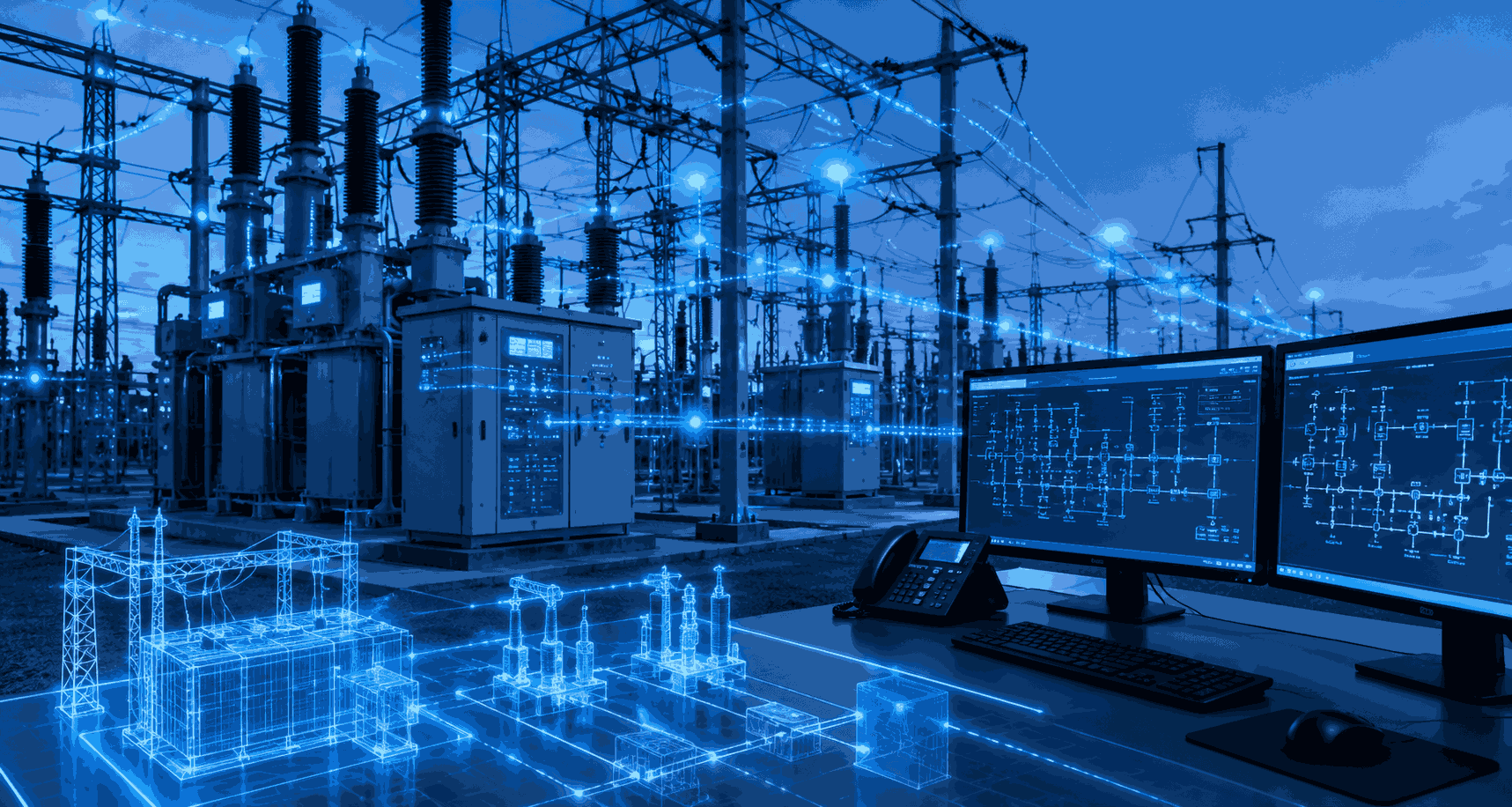
Every substation vendor pitch sounds the same right now: less copper, faster commissioning, full interoperability, “future-ready” infrastructure. What doesn’t show up in the pitch is what happens eighteen months later, when a merging unit from one vendor won’t talk cleanly to a relay from another, a GPS timing glitch trips a protection scheme that was working fine the week before, or the O&M team realizes nobody on staff actually knows how to troubleshoot a process bus.
IEC 61850 is not the problem. It’s a genuinely good standard, and digital substations built on it are, in most cases, the right long-term direction for owners. The problem is that IEC 61850 gets sold as an interoperability guarantee when in practice it’s an engineering discipline one that has to be actively managed through design, procurement, commissioning, and the full operating life of the substation, or the promised benefits don’t show up and the new risks do.
This guide covers what IEC 61850 actually defines, what a digital substation looks like in practice, the problems owners run into most often, and how to structure a project so the standard delivers what it’s supposed to.
What Is IEC 61850?
IEC 61850 is the international standard for communication networks and systems in and around substations. It defines a common, object-oriented data model logical nodes with standardized, meaningful names — so that protection relays, meters, breakers, and other intelligent electronic devices (IEDs) from different manufacturers can exchange information using a shared vocabulary, instead of proprietary point-to-point mapping tables.
Before IEC 61850, integrating a substation typically meant mapping every relay alarm to a DNP3 index, mapping that index to a data concentrator, and mapping it again to a SCADA front end a process where context was easy to lose and expensive to fix. IEC 61850 replaces that index-chasing with a standardized model, which is where most of its real engineering-efficiency gains come from.
Need Engineering Support for Your Power Project?
American Power Engineers delivers power system studies, substation design, renewable energy engineering, BESS projects, NERC compliance, MEP engineering, and POI interconnection services.
Explore Our Engineering ServicesThe standard defines three core communication services that matter most for a digital substation:
- MMS (Manufacturing Message Specification) — client-server communication for monitoring, control, and reporting between IEDs and the station-level SCADA system.
- GOOSE (Generic Object Oriented Substation Event) — fast, peer-to-peer messaging between IEDs for time-critical functions like tripping, interlocking, and blocking, replacing hardwired control cable.
- Sampled Values (SV) — continuous streaming of digitized current and voltage measurements from merging units to protection and control IEDs, replacing hardwired CT/VT copper.
What a Digital Substation Actually Looks Like
“Digital substation” specifically means a substation where Sampled Values have replaced the hardwired analog connections between instrument transformers and protection relays — not just a substation that uses IEC 61850 for SCADA and control (a “hybrid” or “digital control” substation, which is a meaningfully different and lower-risk step).
A full digital substation architecture generally has two distinct communication layers, and understanding where each risk lives depends on knowing which layer it sits on:
Station bus — carries MMS traffic (monitoring, control, reporting) and GOOSE messages between bay-level IEDs and the station HMI/SCADA. This layer has existed in various forms since the early IEC 61850 rollouts and is comparatively mature.
Process bus — carries Sampled Values from merging units out in the switchyard directly to protection relays over fiber, replacing the copper CT/VT wiring entirely. This is the newer, higher-risk layer, and it’s where most of the timing, bandwidth, and vendor-interoperability problems in this guide actually originate.
This distinction matters for owners because “we’re doing IEC 61850” can mean two very different risk profiles depending on whether Sampled Values are in scope. A station-bus-only project and a full process-bus digital substation should not be scoped, tested, or staffed the same way. If you’re weighing which architecture fits your project, this is a conversation worth having early with your substation design engineering team, not after equipment has already been specified.
Planning a Solar, Wind, BESS, or Grid Interconnection Project?
Our engineering team helps project owners, developers, utilities, and facility teams move from technical planning to reliable project execution.
View Engineering ServicesNeed Engineering Support for Your Digital Substation Project?
American Power Engineers delivers power system studies, substation design, renewable energy engineering, BESS projects, NERC compliance, MEP engineering, and POI interconnection services.
Explore Our Engineering Services
Why Owners Are Moving Toward Digital Substations
The benefits driving adoption are real, and they’re worth naming clearly before getting into the problems:
- Dramatically reduced copper wiring. Replacing hardwired trip and CT/VT circuits with fiber and GOOSE/SV messaging cuts material cost, cable routing complexity, and the physical failure points that come with kilometers of control cable.
- Faster, more consistent engineering. Because IEC 61850 uses a standardized data model instead of custom index-mapping, configuration tools can automate work that used to be manual. Industry testing has shown configuration time reductions of over 70% using system configuration tools versus manual point-by-point mapping.
- Virtual testing before energization. A digital substation’s data model can be built and validated in software before physical commissioning, catching design errors on a laptop instead of in the field.
- Better diagnostics and condition monitoring. Digital IEDs report far more operational and health data than electromechanical equivalents, supporting predictive maintenance instead of purely time-based maintenance.
- A path away from vendor lock-in — in theory. A shared data model is supposed to mean relays, merging units, and SCADA from different manufacturers can be mixed. This is the benefit most heavily marketed, and it’s also the one most often overpromised, which is the first problem below.
The Problems Owners Actually Run Into
Most digital substation problems aren’t caused by the standard itself — they’re caused by treating IEC 61850 as a finished, plug-and-play product rather than an engineering process that needs the same rigor as any other protection scheme.
Problem: “Interoperable” doesn’t mean plug-and-play in practice.
IEC 61850 standardizes the data model and communication services, but it doesn’t standardize every implementation choice a vendor makes. Two relays can both be fully IEC 61850-conformant and still require significant engineering effort to work together correctly differing interpretations of optional data attributes, proprietary extensions, and inconsistent SCL (Substation Configuration Language) file handling are common.
Solve it by treating multi-vendor integration as a scoped engineering task with dedicated interoperability testing time in the schedule, not an assumption baked into the procurement spec. Require IEC 61850 conformance test reports from every vendor and budget for factory-level integration testing (FAT) with the actual devices going into your substation, not generic samples.
Problem: Time synchronization is a single point of failure for the whole scheme.
Sampled Values depend on precise, continuous time synchronization typically IEEE 1588 Precision Time Protocol (PTP), often GPS-disciplined to keep data from multiple merging units aligned. Lose that synchronization, even briefly and downstream protection functions can mis-operate or drop out, because the relay can no longer trust that the samples it’s comparing arrived at the same instant.
Solve it by designing redundant time sources from day one GPS plus a second reference (IRIG-B or a grandmaster with holdover capability) plus IED-level internal oscillators rated for the loss-of-sync interval you’re designing against. Time synchronization should be reviewed as a protection-critical system, not a station-services afterthought.
Problem: The attack surface grows as physical wiring disappears.
Every hardwired control circuit that becomes a GOOSE message or Sampled Value stream is now a networked communication that, in principle, can be spoofed, delayed, or disrupted if the network isn’t properly segmented and secured.
Denial-of-service conditions on a station or process bus can affect protection performance in ways a purely hardwired scheme never could.
Solve it by designing network security into the substation architecture itself VLAN segmentation separating station and process bus traffic, access control on engineering ports, and monitoring for anomalous GOOSE/SV traffic and by aligning that design with your NERC CIP obligations from the start rather than retrofitting security controls after commissioning.
Problem: Hybrid substations create more complexity than either full analog or full digital.
Very few owners rip out an entire existing substation and replace it wholesale. Most digital substation projects are partial retrofits, layering IEC 61850 devices onto existing electromechanical or hardwired equipment. The result is a substation running multiple protocols side by side (IEC 61850 alongside DNP3, Modbus, or IEC 60870-5), each with its own mapping and failure modes.
Solve it by documenting the hybrid architecture explicitly as its own design deliverable — not as “IEC 61850 plus legacy,” but as a defined multi-protocol system with its own interoperability testing, failure-mode review, and long-term migration plan toward full digital, if that’s the eventual goal.
Problem: The skillset needed to support a digital substation doesn’t exist in most protection departments yet.
Digital substations sit at the intersection of protection engineering, networking, and cybersecurity. A protection engineer who has never configured a managed Ethernet switch, and a network engineer who doesn’t understand relay coordination, will both struggle to troubleshoot a process bus problem independently. This hybrid skillset is scarce industry-wide, not just at any one utility.
Solve it by building cross-training into the project from the start rather than assuming it will develop organically, and by making sure your commissioning and design partner brings both protection engineering and IEC 61850/networking expertise to the table not one or the other. See our substation protection and control coordination guide for how protection settings and control logic need to be reviewed together even before digital communications are added to the picture.
Problem: Commissioning and testing require different tools and a different mindset.
Traditional substation commissioning relies on injecting test current and voltage directly into hardwired circuits. A process bus substation has no analog test points at the relay testing requires IEC 61850-aware test sets that can simulate Sampled Values and GOOSE messages, along with SCD/ICD file validation that has no equivalent in a conventional commissioning checklist.
Solve it by confirming your commissioning team has IEC 61850-specific test equipment and experience before the schedule is locked and by building SCD file validation and GOOSE/SV simulation into the test plan as a distinct milestone, not a line item folded into general commissioning.
Building a Digital Substation Strategy That Holds Up
Projects that get real, lasting value from IEC 61850 generally get five things right from the start:
- A clear architecture decision, made explicitly. Station-bus-only versus full process bus is a scope decision with major cost, risk, and staffing implications — it should be a deliberate early design choice, not something that gets decided implicitly by whatever equipment gets specified.
- Interoperability testing budgeted as its own line item. Multi-vendor IEC 61850 integration needs dedicated FAT time with the actual specified devices, not a generic assumption that conformant equipment will work together out of the box.
- Time synchronization designed as a protection-critical system. Redundant time sources and a defined loss-of-sync behavior should be part of the protection design review, not the station-services spec.
- Cybersecurity built into the network architecture, not bolted on after. Segmentation, access control, and monitoring should be part of the same design package as the protection and control scheme, reviewed against your NERC CIP obligations from day one.
- A commissioning plan that matches the technology. IEC 61850-aware test tools, SCD/ICD validation, and cross-disciplinary commissioning staff need to be confirmed before the project schedule is finalized, not discovered as a gap during field testing.
Owners who treat these five items as design deliverables the same way they’d treat a relay coordination study or an arc flash assessment consistently avoid the two most expensive digital substation outcomes: field-discovered interoperability failures after energization, and a substation nobody in-house can actually troubleshoot.
Regional and Interconnection Considerations
IEC 61850 architecture decisions don’t happen in isolation from your interconnection requirements. Protection philosophy, redundancy expectations, and even acceptable communication architectures can vary depending on the transmission owner and ISO/RTO you’re interconnecting through, and digital substation designs need to account for that from the start rather than retrofitting to match a region’s requirements late in the project. If you’re bringing a digital substation project online in Texas.
See our Grid Interconnection Engineering for how region-specific protection and communication requirements get layered into the interconnection process from day one.
How American Power Engineers Supports Digital Substation Projects
American Power Engineers provides the engineering foundation for digital substation projects, from architecture decisions through commissioning support.
Our work includes:
- Station-bus and process-bus architecture design and vendor interoperability planning
- Protection coordination and relay setting design for IEC 61850-based schemes
- Time synchronization and network architecture review, including redundancy planning
- Cybersecurity-aligned network segmentation design for station and process bus traffic
- SCD/ICD engineering support and IEC 61850 conformance review
- Hybrid substation migration planning for phased legacy-to-digital transitions
For the full scope of our work on new builds, retrofits, and hybrid architectures, visit our Substation Design engineering services page, or see how substation protection and interconnection requirements come together across a full project in our Substation Design Process 101 guide.
Need Engineering Support for a New or Retrofit Digital Substation?
Our team performs architecture design, protection coordination, and commissioning support for IEC 61850-based substations across North America.
FAQs
What’s the difference between a “digital substation” and a substation that just uses IEC 61850 for SCADA?
A substation using IEC 61850 only at the station bus level for monitoring, control, and reporting is often called a “digital control” or hybrid substation it still uses hardwired copper between instrument transformers and relays. A true digital substation extends IEC 61850 down to the process bus, using merging units and Sampled Values to replace that copper entirely. The risk, cost, and skillset requirements are meaningfully different between the two, so it matters which one a project actually means.
Does IEC 61850 guarantee that relays from different manufacturers will work together?
Not automatically. IEC 61850 standardizes the data model and communication services, but vendors still make different implementation choices, use proprietary extensions, and interpret optional attributes differently. Conformant equipment from different manufacturers generally can be integrated, but it requires dedicated interoperability engineering and testing it isn’t a plug-and-play guarantee.
What is a merging unit, and why does it matter for a digital substation?
A merging unit digitizes analog current and voltage signals from conventional or non-conventional instrument transformers out in the switchyard and streams them as Sampled Values over the process bus. It’s the component that physically replaces the hardwired CT/VT wiring in a full digital substation, which makes its accuracy, timing performance, and failure behavior directly critical to protection performance.
How does time synchronization failure affect a digital substation’s protection?
Sampled Values from multiple merging units have to be time-aligned for a protection relay to compare them correctly. If IEEE 1588 PTP synchronization is lost or degrades beyond the relay’s tolerance from GPS spoofing, interference, or equipment failure protection functions relying on that data can misoperate, block, or drop out entirely. This is why redundant time sources are treated as a protection-critical design element, not a convenience feature.
Are digital substations more vulnerable to cyberattacks than conventional substations?
The attack surface changes rather than simply growing. Conventional hardwired schemes have essentially no remote attack surface at the wiring level, while digital substations move critical communication onto Ethernet networks that can, in principle, be targeted by denial-of-service or spoofing attacks if not properly segmented and secured. This is manageable with proper network architecture and monitoring, but it has to be designed in rather than assumed away.
Can an existing substation be converted to a digital substation without a full rebuild?
Often yes, but it’s rarely a clean swap. Most owners implement digital substation elements as a phased retrofit adding IEC 61850-based protection and control at the station bus level first, and moving to process bus/Sampled Values selectively as equipment reaches end of life. The resulting hybrid architecture needs to be engineered and documented as its own system, not treated as a temporary state that resolves itself.
What should owners require from vendors before specifying IEC 61850 equipment?
At minimum: current IEC 61850 conformance test reports for the specific device models being proposed, documented support for the SCL file exchange your integration will rely on, and a clear answer on which edition of the standard (Edition 1 vs Edition 2) the equipment supports, since the two aren’t fully backward compatible in all respects. Vendor claims of “full interoperability” should be validated through your own FAT process, not accepted at face value.
Work With American Power Engineers
Expert engineering support for digital substation architecture, protection and control coordination, power system studies, and interconnection services.
Related Services:
- Owner’s Technical Advisory
- Power System Studies
- POI Interconnection Engineering
- NERC O&P 693 Compliance Services
Related Reading:
Work With American Power Engineers
Expert engineering support for power system studies, substation design, renewable energy projects, BESS engineering, NERC compliance, MEP engineering, and POI interconnection services.
Explore All Engineering Services